My latest polling asks what people made of John Healey’s Budget, whether we should rejoin the EU and what conditions would be acceptable, whether Britain needs steady management or radical change, and when we should hold a general election.
The Budget – what did people notice?
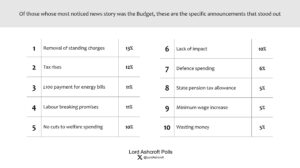
The Budget was overwhelmingly the most noticed recent political story, mentioned unprompted by more than half of all respondents. The most recalled Budget measures were the removal of standing charges on gas bills, tax rises, the £100 payment towards energy bills for those in Council Tax bands A to D and the absence of cuts to welfare spending.
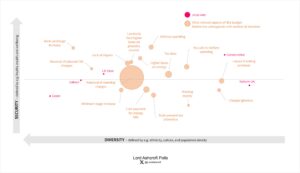
Our political map shows which kinds of voters were most likely to recall which Budget measures. Removal of standing charges and the £100 energy bill payment appear close to the centre of the map, showing they were recalled in similar proportion throughout the electorate. The minimum wage increase, the reversal of planned changes to the cash ISA allowance announced by Rachel Reeves and higher taxes on banks were most likely to be mentioned in Labour and Lib Dem territory on the left-hand side of the map. Other tax rises and the absence of welfare cuts were most likely to be named in the Conservative-leaning top right quadrant, while gherkins and wasted spending were most likely to be mentioned in the Reform-leaning bottom right.
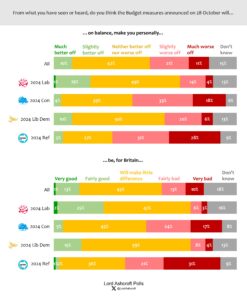
Overall, voters thought the Budget would make them personally worse off by a 22-point margin, with 42 per cent saying it would make no difference. Among 2024 voters, only those who voted Labour were more likely to say the Budget would make them better off (albeit by only two points), but with nearly half saying it would make no real difference.
When it came to the impact on the country as a whole, people were more likely to say the Budget was bad rather than good for Britain by a 9-point margin, but with 45 per cent saying it would make no difference. Labour, Lib Dem and Green voters were more likely to say the Budget would be good for the country than bad.
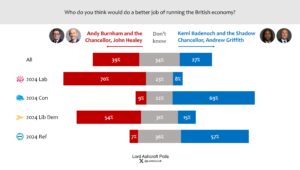
Andy Burnham and John Healey led Kemi Badenoch and Andrew Griffith by 12 points when it came to who would do a better job managing the economy. At the end of May, Badenoch and Mel Stride led Keir Starmer and Rachel Reeves by 5 points.
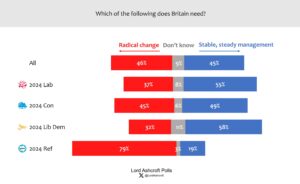
Voters overall were evenly divided between thinking Britain needed radical change or steady, stable management. 2024 Conservatives were also quite evenly divided. 2024 Reform voters wanted radical change by a 60-point margin; Labour and Lib Dem voters wanted steady, stable management by 18 points and 26 points respectively.
Rejoining the EU and free movement
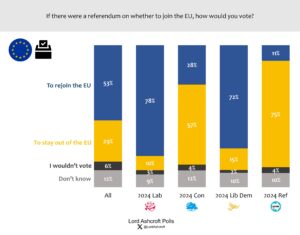
Voters as a whole said they would vote to rejoin the EU by 53 per cent to 29 per cent, with a further 18 per cent saying they didn’t know or wouldn’t vote. One in three current Conservative leaners and 28 per cent of 2024 Conservatives said they would vote to rejoin.
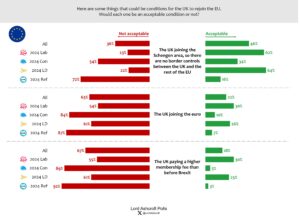
Voters said that joining the euro would be an unacceptable condition of EU membership by a 41-point margin. Clear majorities of Conservative, Labour, Lib Dem and Reform voters were against joining the euro, as were a plurality of Green voters. SNP supporters were more likely to support than oppose joining the euro. Paying a higher membership fee than before Brexit was also rejected by a 49-point margin. All parties’ voters agreed, with the exception of current Green supporters who said this would be acceptable a 1-point margin. Voters said joining the Schengen area was acceptable by a 10-point margin. Majorities of Labour, Lib Dem, Green and SNP voters agreed, while majorities of Conservative and Labour voters said this would be an unacceptable condition.
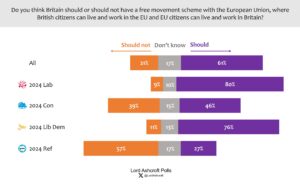
Voters overall said they favoured a return to free movement with the EU by a 40-point margin. Reform UK voters were the only group more likely to be against a the idea than in favour.
Parties and leaders
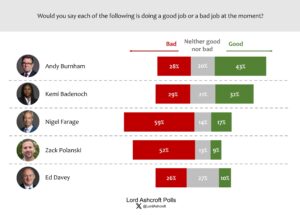
Voters said Andy Burnham was doing a good job rather than a bad job by a 15-point margin, and Kemi Badenoch by a 3-point margin. Ed Davey was thought to be doing a bad job by a 16-point margin, Nigel Farage by a 42-point margin and Zack Polanski by a 43-point margin. Burnham received the highest net score among his own party’s current likely voters (+89), followed by Badenoch (+74), Farage (+73), Polanski (+37) and Davey (+33).
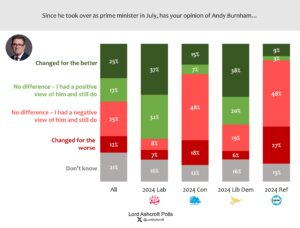
Voters were more likely to say their view of Andy Burnham had changed for the better since he took over (25 per cent) than for the worse (12 per cent).
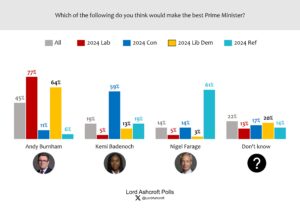
Asked whether Burnham, Badenoch and Farage would make the best PM, voters chose Burnham over Badenoch by a 26-point margin, with Farage third on 14 per cent. More than three quarters of 2024 Labour voters preferred Burnham (compared to 65 per cent who preferred Starmer in June).
In a head-to-head, Burnham led Badenoch by 45 per cent to 27 per cent, a lead of 18 points (unchanged from last month). Given a choice between Burnham and Farage, voters chose Burnham by a 34-point margin. Those who voted Conservative in 2024 were quite evenly divided between Farage (37 per cent) and Burnham (35 per cent).
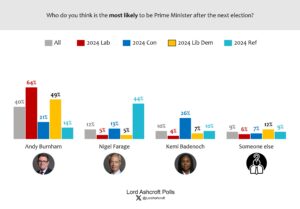
Andy Burnham remains the leader voters consider most likely to be PM after the next general election, named by 40 per cent, with 12 per cent naming Farage and 10 per cent naming Badenoch.
The political map
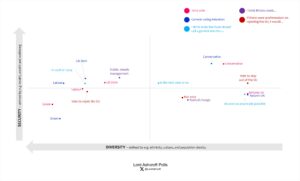
As above, our political map shows how different issues, attributes, personalities and opinions interact with one another. Each point shows where we are most likely to find people with that characteristic or opinion; the closer the plot points are to each other the more closely related they are. Here we see where within the electorate we are most likely to find particular views on EU membership, general election timing, and whether Britain needs steady management or radical change.
Next general election
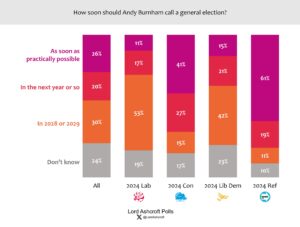
Voters overall were fairly evenly divided between wanting an election as soon as practically possible. in the next year or so and in 2028 or 2029. Just over four in ten 2024 Conservatives and more than six in ten Reform UK voters said they wanted an election as soon as possible; a majority of 2024 Labour voters preferred to wait until at least 2028.
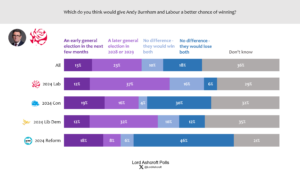
Voters as a whole thought Labour would have a better chance of winning a later general election than an earlier one. Just under one in five thought they would lose both and only one in ten thought they would win both. Conservative and Reform voters were more likely to think Labour would have a better chance by going earlier rather than later; Labour supporters were more likely to think they would have a better chance by waiting until 2028 or 2029.
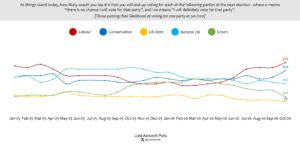
Unlike most pollsters, I ask how likely people think they are to vote for each party at the next election on a scale from zero to one hundred, rather than which they would pick in a hypothetical election tomorrow. Taking those who put their chances of voting for one party at 50+ out of 100, and weighted by likelihood to turn out and vote, we find vote shares of Labour 31 per cent, Conservatives 26 per cent, Reform UK 18 per cent, Greens 10 per cent, Lib Dems 7 per cent, Others 8 per cent.