My latest polling asks how well each of the party leaders is doing, what people think of new Conservative welfare policies, how the Chancellor should tackle rising debt in next month’s Budget, whether artificial intelligence is a force for good and whether governments can and should regulate it.
Leader performance
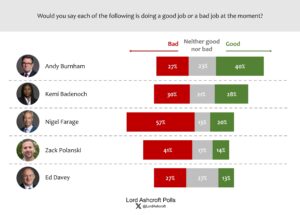
Voters said Andy Burnham was doing a good job by a 13-point margin, and opinion was closely divided on Kemi Badenoch. Ed Davey was thought to be doing a bad job by a 14-point margin, and Nigel Farage and Zack Polanski a bad job by a 27-point margin. Burnham received the highest net score among his own party’s current likely voters (+85), followed by Farage (+78), Badenoch (+72), Polanski (+44) and Davey (+35).
The Conservatives
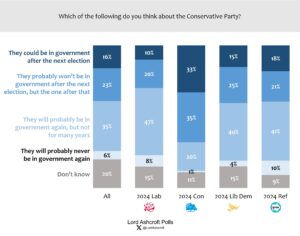
Just under four in ten said they thought the Conservatives could be in government again either after the next election (16 per cent) or the one after that (23 per cent). Just over one third said they thought the party would be in government again, but not for many years. Only six per cent thought they would never be in government again.
Just under seven in ten of those who voted Conservative in 2024 thought the party could be in government after the next election or the one after, as did 81 per cent of those currently leaning towards the Conservatives (including 45 per cent who thought they could be back in government after the next election).
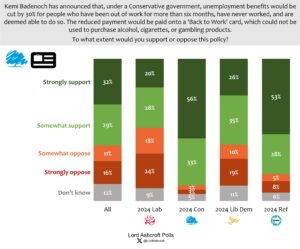
By a 34-point margin, voters as a whole supported the new Conservative policy on cutting benefits for long-term unemployed people deemed fit to work and preventing them being spent on alcohol, tobacco and gambling. The policy was backed by nearly nine out of ten Conservative voters, more than eight in ten Reform voters, and a plurality of Labour and Lib Dem voters. Current Green voters opposed the policy by 13 points and SNP voters by three points.
The economy and the Budget
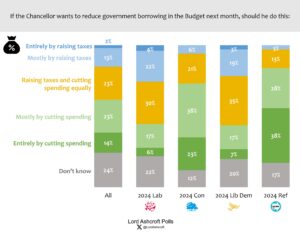
If the Chancellor aims to reduce borrowing in the Budget, voters said he should do so by cutting spending rather than raising taxes by 37 per cent to 15 per cent, with jus under a quarter saying he should do both equally. Those who voted Labour in 2024 were fairly evenly divided between tax rises and spending cuts.
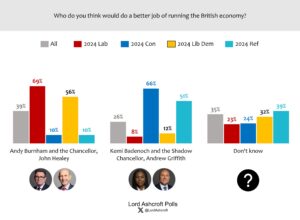
Andy Burnham and John Healey led Kemi Badenoch and Andrew Griffith by 13 points when it came to who would do a better job managing the economy. At the end of May, Badenoch and Mel Stride led Keir Starmer and Rachel Reeves by 5 points.
Artificial intelligence
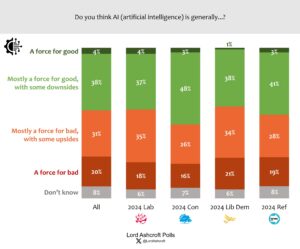
Overall, people tended to see AI as a force for bad rather than good by a nine-point margin. They were significantly more likely to see AI as a force entirely for bad than entirely for good, and were more likely to see it as mostly a force for good with some downsides or mostly for bad with some upsides. Conservative, Labour, Lib Dem and Reform voters were notably more likely to see AI as a force for good than Green and SNP supporters.
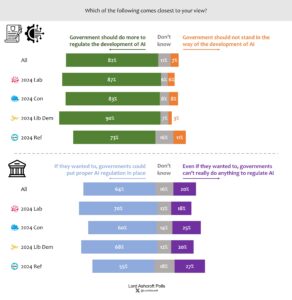
More than eight in ten voters – including large majorities of all voter groups – said that government should do more to regulate the development of AI. Reform voters were the least likely to say this, but still nearly three quarters agreed. Slightly fewer overall – but still nearly two thirds – agreed that if they wanted to, governments could put proper AI regulation in place. Around a quarter of Conservative and Reform voters thought governments can’t really do anything to regulate AI even if they wanted to.
Best PM and the next election
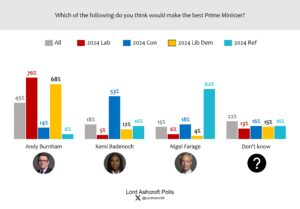
Offered a choice between Burnham, Badenoch and Farage, voters chose Burnham over Badenoch by a 27-point margin, with Farage third on 15 per cent. More than three quarters of 2024 Labour voters preferred Burnham (compared to 65 per cent who preferred Starmer in June).
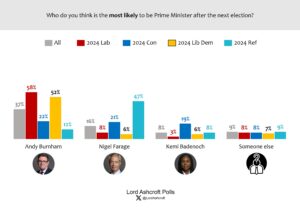
Andy Burnham remains the leader voters consider most likely to be PM after the next general election, named by 37 per cent, with 16 naming Farage. Just over half (57 per cent) of those currently intending to vote Reform thought Farage would be PM, while more than three quarters of Labour leaners expect Burnham to be PM.
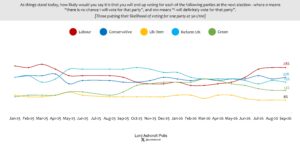
Unlike most pollsters, I ask how likely people think they are to vote for each party at the next election on a scale from zero to one hundred, rather than which they would pick in a hypothetical election tomorrow. Taking those who put their chances of voting for one party at 50+ out of 100, and weighted by likelihood to turn out and vote, we find vote shares of Labour 28 per cent, Conservative 22 per cent, Reform UK 19 per cent, Green 14 per cent, Lib Dems 8 per cent, Others 9 per cent.
The political map
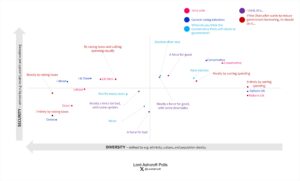
Our political map shows how different issues, attributes, personalities and opinions interact with one another. Each point shows where we are most likely to find people with that characteristic or opinion; the closer the plot points are to each other the more closely related they are. Here we see what different kinds of voters think about AI, how the Chancellor should go about reducing borrowing, and when the Conservatives are likely to return to government.