With the conference season behind us, the Budget on 28 October is the next big test. Each of the three main leaders approaches it with a different question hanging over them. Andy Burnham has given Labour a second chance: will it survive the hard decisions of government, starting with the Chancellor’s? Kemi Badenoch’s personal ratings have improved, yet the Conservatives remain stuck below their 2024 vote share: can she lift the party as well as herself? And Nigel Farage’s summer of financial scandal has tested whether Reform UK’s support is really his.
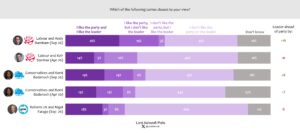
Our recent polling gets at all three by asking about party and leader together. People could say they liked both, liked the leader but not the party, liked the party but not the leader, or disliked both. The chart compares the results with April, when we asked the same question about Keir Starmer and Labour and about Badenoch and the Conservatives, days before the local and devolved elections.
Burnham: new leader, not a new party
Labour’s own standing has not moved: 30 per cent liked the party in April and 29 did so in September, with around 55 per cent disliking it both times. What has changed is the leader. In April, those who liked Labour were more likely to dislike Starmer than like him. Now almost nobody who likes Labour dislikes Andy Burnham, and a further 19 per cent of the public like him without liking his party. As a result, he runs 16 points ahead of Labour where Starmer ran 11 points behind.
Badenoch’s gains are smaller but steady. She is now liked by a third of the public, up from 28 per cent in April, and consistently runs ahead of her party: twice as many people like her but not the Tories as the other way round. The party itself is still the least liked of the three, liked by 25 per cent and disliked by 57 per cent.
Reform UK is different. Views of the party and of Nigel Farage move together: 79 per cent of people hold the same view of both, against around three in five for Labour and the Conservatives. Where there is a gap, it runs against Farage: more people like Reform but not him than the reverse, and a clear majority of the public dislike both.
Converting goodwill into votes
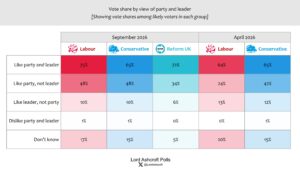
The table shows how each party polls among the four groups. People who like both the party and its leader are the low-hanging fruit, but the parties pick it at different rates: Labour takes 75 per cent of the vote among those who like it and Burnham, Reform 72 per cent among those who like it and Farage, but the Conservatives only 65 per cent among those who like them and Badenoch.
The Conservatives’ problem is competition on their own side. Two in five of the people who like the Conservatives and Badenoch also like Reform UK and Farage; this group is close to 9 per cent of the population, and within it Reform leads the Conservatives by 55 per cent to 35 per cent. The equivalent overlaps among people who like Labour and either of the parties on the right are much smaller – around 1 per cent each – and Labour’s leakage from those who like both Burnham and Labour goes roughly evenly to the Greens and the Lib Dems. Reform is a far more serious rival to the Conservatives than the Greens are to Labour.
The gap between the first two rows of the table measures how much a leader repels the party’s own supporters: the party’s vote share among people who like it and its leader, against its share among people who like the party but not the leader.

Starmer’s 40-point penalty in April was the stark measure of a leader driving away his party’s natural supporters. Nigel Farage’s 38 points is in the same territory: Reform holds only a third of the vote among people who like the party but not him, where Labour and the Conservatives hold about half. However, just 30 per cent of the people who like Reform dislike Farage; 54 per cent of the people who liked Labour in April disliked Starmer.
Who are the split groups?
People who like a leader but not the party rarely vote for it, as the third row of the table shows. But with the election more than two years away, these are the people from whom any party’s growth is most likely to come. The chances of this happening depends on where they sit politically. Below, each group is placed on our political map; the groups with split views are highlighted, with the like-both and dislike-both groups shown faintly for reference.
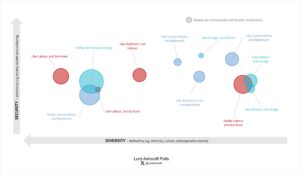
People who like Badenoch but not her party sit at about “3 o’clock”, the territory of people who voted Conservative in 2019 but not in 2024, and closer to today’s Reform voters than to today’s Conservatives. These are exactly the voters a Conservative recovery depends on, and it is she, not the party, who currently reaches them. The smaller group who like the Conservatives but not Badenoch sit at “1 o’clock”, in the middle of the current Conservative vote; no other party comes close to their economic outlook, and that will be truer still if Burnham moves Labour leftwards.
The people who like Burnham but not Labour sit squarely in the centre of the map. That is a feature of the honeymoon, not a shared political outlook: 41 per cent of them put their chance of voting Labour at the next election at zero. The small group who like Labour but not Burnham sit at about “8.30”, where we find the people who backed Labour under Jeremy Corbyn and left in 2024; they want more left-wing economics than the 2024 manifesto and the fiscal rules allow, and they will be the main targets of the parties to Labour’s left. Burnham’s ratings buy time to build these voters into a coalition for the next election, but they are not yet that coalition.
The small group who like Farage but not Reform UK sit at “1.30”, in the centre of Conservative territory, and vote accordingly: the Conservatives take 64 per cent of this group and Reform 6 per cent. Those who like Reform but not Farage sit at “3.30”, close to current Reform voters and to supporters of minor parties, chiefly Restore Britain. Reform and the Conservatives one third each of this group, and 20 per cent intend to vote for a minor party.
The voters the parties need
Now to the voters each party is actually trying to win. Every month we ask people to rate, from 0 to 100, how likely they are to vote for each party at the next election. We call those scoring a party between 25 and 50 its potential voters: people giving it real consideration without currently supporting it. Potential Labour and potential Conservative voters are each 15 per cent of the population; potential Reform voters are 8 per cent.
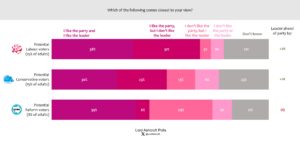
Reform’s potential voters are much more likely than the public as a whole to hold split views of Reform and Farage, and the split is lopsided: Farage repels nearly five times as many potential Reform voters as he attracts. Dislike of Farage, distinct from dislike of Reform, is concentrated among the people Reform needs to convert.
The Conservatives have the opposite problem. Badenoch is liked by just over half of the party’s potential voters, and again nearly twice as many like her but not the party as the reverse. However, the net “liked” score among the Tories’ potential voters (the proportion liking the party minus the proportion disliking it) is only 13 points, compared to 24 for Labour and 56 for Reform. Only 30 per cent of potential Conservatives like both party and leader, compared with 38 per cent for Labour and 39 per cent for Reform. In other words, the residual unpopularity of the Conservative Party is still biting among the very voters it needs to win back.
So each leader goes into the Budget with a different burden: Burnham is carrying his party, and will find out after 28 October how much of his goodwill survives contact with fiscal reality; Badenoch is carrying hers too, but it is a heavier load and she has further to go; Farage, for the first time, is being carried by his.
The problem all three share
Whoever is carrying whom, all three parties need to widen their appeal. The Budget is the first substantive test of how Burnham uses his personal standing, and of how Badenoch and Reform respond to it. To look at that we return to the political map, this time with the public’s priorities on it.
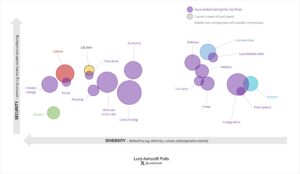
The map places each party’s current voters alongside the issues the public pick as their top three. Labour’s voters sit just above “9 o’clock”; the issues nearest to them are Brexit, education and climate change. The big ones, the NHS, housing and above all the cost of living, lie between Labour and the centre of the map; the cost of living, the public’s biggest concern by some distance, sits closer to the centre than any party. Immigration, the second biggest, sits on top of Reform. The Conservatives at “1 o’clock are nearest to defence, welfare and government debt”.
The Budget: a cost-of-living pitch to Labour’s own ground
Burnham arrived in Number 10 promising a “cost of living government”. His early actions featured bus fares and VAT on electricity bills, a conference speech built around housing, living costs and social care, a swipe at Brexit, the talk of removing standing charges from energy bills and the speculation about bank taxes. All of this is addressed to the economically left-wing, traditional Labour territory in the bottom-left of the map. We can expect the Budget to make the same case: bolder and more traditionally Labour, but inside the fiscal rules and the manifesto’s tax pledges. Two fault lines inside Labour’s current vote suggest what will be missing.
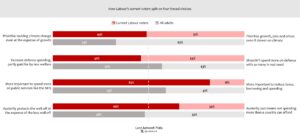
Labour voters lean heavily one way on spending against tax cuts and on austerity, and split down the middle on climate action versus economic growth and on defence versus welfare. The climate split explains the PM’s reticence on the subject at conference and the decision to approve Jackdaw, and the Greens’ shift from being an environmental to an eco-socialist party gives him some latitude.
The defence split is harder for Burnham to navigate. More defence spending means tax rises, cuts elsewhere or more borrowing, and the Chancellor looks unlikely to answer the question of defence spending over which he resigned in the summer. Blame for the economy still falls elsewhere, with 66 per cent attributing Britain’s problems to global factors or previous Conservative governments and 34 per cent to Labour, providing some cushion for the government, at least for the time being.
John Healey is still relatively little-known as Chancellor, so the Budget is a first impression. People who see Burnham’s government as a change from Starmer’s like Burnham by a 63-point margin, while those who see it as more of the same dislike him by 38. For the Budget to be seen as “continuity Starmer” would be more damaging for Labour than if it were seen to signal a lurch to the left.
After the Budget: the barriers
We asked people who rated their chance of voting for a party between 1 and 50 why, since they had not ruled it out, they were unlikely to vote for it. The chart shows the answers of each party’s “potential voters”, the 25–50 group defined above.
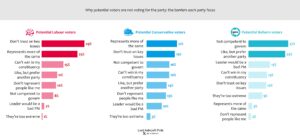
Each party faces a different barrier. For Reform it is viability: 27 per cent of its potential voters say it is not competent to govern, 25 per cent like it but think another party would do better in government, and 15 per cent doubt Farage as PM. For Labour it is change: 29 per cent do not trust it on key issues and 25 per cent say it represents more of the same. These are people who give Labour serious consideration, so the distrust is more about delivery than values, and 49 per cent of this group currently intend to vote Green. Reform need people and expertise that make a party look like a government in waiting; Labour need to set a direction and deliver enough of it. Neither is easy, but each party’s main task is reasonably clear.
This is less true for the Conservatives. “More of the same” and distrust top their list, as they do for Labour, but competence, preferring another party, and doubts about Badenoch all follow, and seven of the eight reasons are given by at least 10 per cent of their potential voters; only “too extreme” is not. “Don’t represent people like me” is mentioned by 13 per cent of potential Conservative voters; among everyone scoring the party 1–50 it rises to 21 per cent, second on the list. That is a reputational problem specific to the Conservatives.
The Conservatives: two flanks and a middle
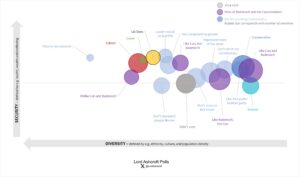
Potential Conservative voters fall into three broad groups. On one flank, around “3 o’clock”, are people who did not vote or voted Reform in 2024. This is where we are also most likely to find those who distrust the Conservatives on key issues, and those who like Badenoch but not her party. She reaches this flank; the party does not. On the other, around “12 o’clock”, are potential Conservative voters who backed Labour, the Lib Dems or Greens last time. This is where we are also most likely to find doubts about competence, about Badenoch as PM, and those who like the party but not its leader. The party reaches this flank; she does not. Between them, around “2 o’clock”, sit 2024 Conservatives who like both party and leader and hold back because they think the Conservatives cannot win or that another party would do better. The “don’t represent people like me” group sits in the centre of the map, with no distinctive outlook or demographic profile.
The “3 o’clock” flank got high taxes and high immigration from a party that promised the opposite in 2019, and the task is to convince them it will not happen again. The Conservatives have set out tougher positions on net zero, housing, welfare and asylum and made accepting them a condition for prospective Conservative candidates. Badenoch cannot ignore immigration, but Farage will argue that the Tories had fourteen years to fix it. She must convince voters that she is prepared to act.
The “12 o’clock” flank is more concerned about the economy. Many voted Conservative in 2019 as a tactical anti-Corbyn vote while liking neither Johnson nor Brexit; Starmer made Labour as inoffensive to them as he could in 2024, and a more left-wing Labour that might be propped up by nationalists or Greens is less palatable. This is also where people are most likely to mention, unprompted, Labour’s rise in employer’s National Insurance and the minimum wage. For these less tribal, more transactional voters, a credible economic offer would go some way to settling their doubts about competence.
Progress on both flanks that lifted Conservative ratings should help activate the “2 o’clock” group, who are largely content to vote for whichever right-of-centre party looks the safer bet in their seat. Without such an advance, they could conclude the Conservatives cannot win.
The voters agree change is needed, though they disagree on what kind. Reform’s problem is that the voters it needs fear it can’t deliver change; Labour’s is that the voters it needs fear it won’t. The Conservatives have both problems at once.