My latest poll looks in detail at the characters of the main parties and their leaders, whether people’s front doors are open, ajar or closed to each one, what they think of Number 10 North, the pensions triple lock, what they expect in next month’s Budget and whether they think Andy Burnham will try to rejoin the EU.
What have people noticed – and who noticed what?
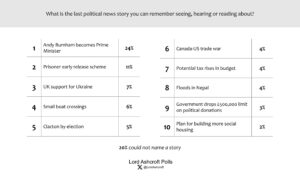
Beyond Burnham becoming prime minister, the prisoner early release scheme was the political news story most often spontaneously recalled in our poll. This was followed by British support for Ukraine, small boat crossings, and the Clacton by-election.
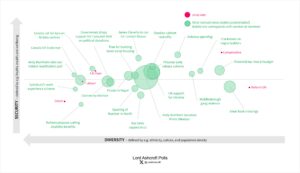
Our political map shows which kinds of voters were most likely to mention which stories. Burnham becoming PM, prisoner early release and Ukraine were all close to the centre of the map, showing that they were recalled fairly evenly throughout the population. Stories about small boat crossings, gang violence, Budget tax rises and defence spending were more likely to be mentioned on the Conservative or Reform-leaning right-hand side of the map. News about the Clacton by-election, US-Canada trade and benefit cuts were more likely to be mentioned in Labour, Lib Dem and Green-voting territory.
What has the Labour government done?
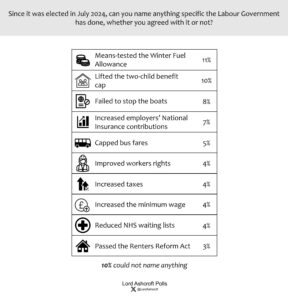
When we asked people to name specific things the Labour government had done since it was elected in 2024, only one – capping bus fares, the fifth most-mentioned item – dated from Burnham’s time in office. Starmer-era issues like the winter fuel allowance, lifting the two-child benefit cap, small boats and Employers’ National Insurance were again more likely to be named.
Our political map shows that tax rises, U-turns, early prisoner release and lack of action on small boats were most likely to be mentioned in Conservative and Reform-leaning territory, while benefit cuts, weapons sales to Israel, the Renters Reform Act, school breakfast clubs, raising the minimum wage and removing VAT from electricity bills were more often recalled on the left. Employers’ National Insurance, the two-child benefit cap and the winter fuel allowance were more universally mentioned.
Parties and leaders
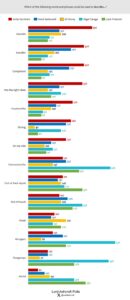
The seven most frequently chosen words and phrases for Andy Burnham were all positive: “likeable”, “competent”, “sensible”, “has the right ideas”, “trustworthy”, “strong”, and “on my side”. “Out of their depth” and “untrustworthy” were the most frequent negative choices. “Sensible” and “competent” were the two most frequent choices for Kemi Badenoch, though this was followed closely by “out of touch”.
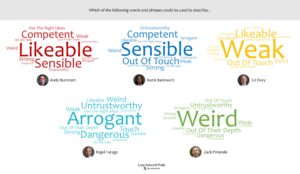
The top six choices for Nigel Farage were negative: “arrogant”, “untrustworthy”, “dangerous”, “out of touch”, “weird” and “out of their depth”. “Strong” was the most frequent positive choice. All seven negative words and phrases were chosen for Zack Polanski (especially “weird” and “out of their depth”) before any of the positive ones (the most frequently selected one of which was “has the right ideas”). “Weak” was the most frequently chosen word for Ed Davey, with “likeable” in second place.
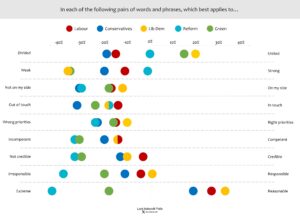
We offered respondents opposing pairs of words and phrases and asked which most applied to each party. Reform were more likely than the Conservatives to be seen as united, strong and in touch. The Conservatives were more likely than Reform to be seen as competent, credible, responsible and reasonable. Labour were ahead of the Conservatives on all positive attributes. Labour were more likely than Reform to be seen as on my side, having the right priorities, competent, responsible and reasonable.
The Budget
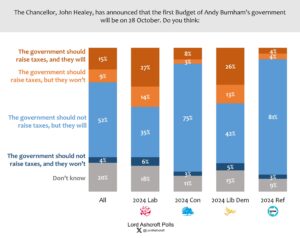
Two thirds of voters said they expected taxes to rise in the Budget, including a majority who said the government should not raise taxes, but they will. More than six in ten 2024 Labour voters expected taxes to rise, including 35 per cent who said they shouldn’t rise but would.
The pension triple lock
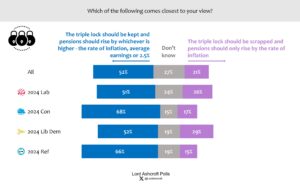
Just over half, including more than two thirds of 2024 Conservative and Reform voters said the pensions triple lockshould be kept. Only just over one in five said the lock should be scrapped and pensions should rise only by the rate of inflation. Just under a quarter of 18-24 year-olds said it should be kept, compared to more than six in ten of those aged 50-64 and 80 per cent of those aged 65 or over.
Number 10 North
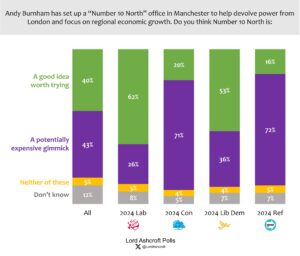
Voters overall were divided as to whether Number 10 North was a good idea worth trying or a potentially expensive gimmick. Majorities of Labour and Lib Dem voters said it was a good idea, while bigger majorities of Conservative and Reform voters said the opposite.
Rejoining the EU
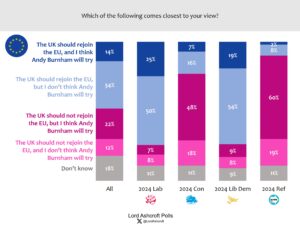
Overall, 48 per cent (including around three quarters of 2024 Labour and Lib Dem voters) said Britain should rejoin the EU, whether or not they thought Andy Burnham would try to do so. Thirty-six per cent thought Burnham would try to rejoin the EU, whether or not they thought that would be a good idea. Just under a quarter (23%) of 2024 Conservatives said they thought the UK should rejoin.
Russian threats
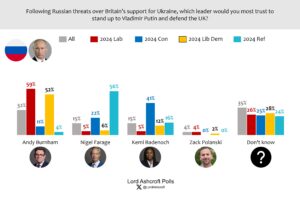
Andy Burnham was the leader most trusted to stand up to Putin and defend the UK, chosen by 32 per cent. Badenoch and Farage were equal second, named by 15 per cent each.
Best and most likely prime minister
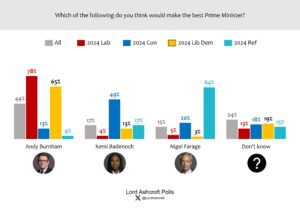
Offered a choice between Burnham, Badenoch and Farage, voters chose Starmer over Badenoch by a 27-point margin, with Farage third on 15 per cent – all unchanged from last month. Just under eight in ten 2024 Labour voters preferred Burnham, compared to 65 per cent who preferred Starmer in June.
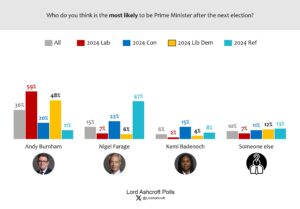
Andy Burnham remains the leader voters consider most likely to be PM after the next general election, named by 36 per cent. Fifteen per cent named Farage. Just over six in ten of those currently intending to vote Reform thought Farage would be PM, while 77 per cent of Labour leaners expect Burnham to be PM.
The political map
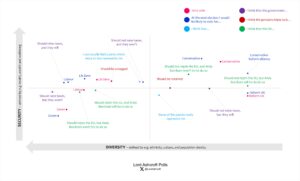
As above, our political map shows how different issues, attributes, personalities and opinions interact with one another. Each point shows where we are most likely to find people with that characteristic or opinion; the closer the plot points are to each other the more closely related they are. Here we see what different kinds of voters want and expect from the Budget and Burnham’s approach to the EU, and their views about the pension triple lock.
The next election
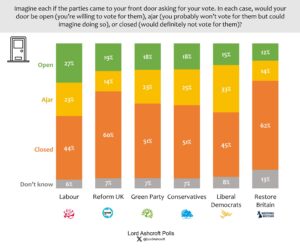
Voters were most open to considering Labour: 27 per cent said their door was open, 23 per cent ajar and 44 per cent closed. The Lib Dems had the largest “ajar” constituency. Just over half said they were closed to the Conservatives and Greens, and 60 per cent to Reform UK – only just under the proportion saying they were closed to Restore Britain.
Half of those currently leading towards the Conservative said they were open or ajar to Reform, and nearly two-thirds of Reform voters to the Conservatives, but only one in ten Reform voters would consider Labour. On the other side, two-thirds of current Labour voters said they would consider the Greens and three-quarters the Lib Dems, and vice versa. Reform voters were more likely to say they were open or ajar to Restore Britain than to the Conservatives.
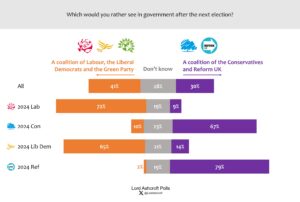
Just over four in ten (41 per cent) said they would prefer to see a coalition between Labour, the Lib Dems and the Greens after the next election, while 30 per cent chose a Conservative-Reform coalition. Only two thirds of 2024 Tories leaners said they would prefer a Conservative-Reform government (with nearly a quarter saying “don’t know”), compared to nearly 8 in 10 Reform voters.
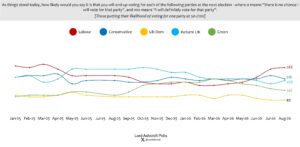
Unlike most pollsters, I ask how likely people think they are to vote for each party at the next election on a scale from zero to one hundred, rather than which they would pick in a hypothetical election tomorrow. Taking those who put their chances of voting for one party at 50+ out of 100, and weighted by likelihood to turn out and vote, we find vote shares of Labour 28 per cent, Conservative 21 per cent, Reform UK 20 per cent, Green 14 per cent, Lib Dems 8 per cent, Others 9 per cent.