As Lady Bracknell didn’t quite say, to lose one prime minister before they have served four years may be regarded as a misfortune; to lose five in a row looks like carelessness – or worse. Some argue that a nefarious combination of factors including Brexit, the media, the centralised state, unaccountable elites, the bond markets and political and cultural polarisation has made the job of leading Britain more or less impossible. Did Keir Starmer lose his job because he wasn’t very good at it, or because it can’t be done? And as Andy Burnham settles in at Number 10, do voters think Britain is ungovernable? Or just that it has been badly governed?
We can look in detail at three arguments: that it is impossible to maintaining a governing coalition while making painful decisions in office; that the cost of living crisis and the 24-hour news cycle have made people too impatient for change; and that voters are unwilling to accept the consequences of trade-offs between taxes and state spending, while populist parties claim this circle can be squared.
The starting point is that Keir Starmer’s defenestration followed two disastrous sets of local elections – not to mention hundreds of polls – suggesting that he was leading the Labour party down the road to defeat. It is worth noting that Labour started 2025 with a slender polling lead; by the end of that year they were in third place, with Reform well ahead.
Since January 2025 my monthly surveys have asked people what they have noticed that the Labour government had done since taking office. Crucially, they were not choosing from a pre-defined list – they could write anything. This gives us a record of what voters observed month by month over the Starmer premiership. The chart below shows the fifteen most frequent answers over that time and the proportion of respondents mentioning them in each survey.
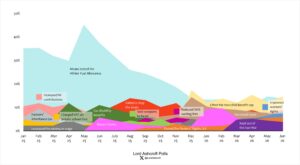
This suggests that Starmer’s time as PM falls into three chapters. The focal point of the first chapter is the decision to means-test the winter fuel allowance (the fact that the policy was announced in the government’s first month in office and still dominated recall six months later suggests the second half of 2024 can be considered part of this phase). The chapter closes with the U-turn following Labour’s hammering in the 2025 local elections.
The second chapter opens in July 2025 and still has the Winter Fuel Allowance as the most-noticed action, albeit being mentioned less frequently, with small boat crossings consistently in second place. This chapter ends in December with some spikes relating to Rachel Reeves’ budget. The final chapter, covering 2026, does not have a clear-cut narrative: there is not a consistent most-noticed action.
Some of the successes the government claim – such as raising the minimum wage, cutting NHS waiting lists and improving worker’s rights – appear in the chart. But none of these ever attracted the notice of even ten per cent of respondents or made it into the three most noticed actions in a month. This itself says a lot about a government which was never able to articulate a clear vision or plan. Instead, the government allowed itself to be defined by the decision on the winter fuel allowance. Historians of Starmer’s premiership will puzzle over the decision to spend so much political capital on a policy which would save, in the context of government spending, a tiny amount of money – especially as few people were demanding any such action.
Another way to look at the things people noticed about Starmer’s government is to group them into the following four categories. Inevitably, deciding which actions fall into which category is somewhat subjective, but the goal is to look at general trends rather than precise figures.
- Unforced errors, of which winter fuel is the most obvious, but which also includes scandals and other policy U-turns. (This doesn’t include things which simply proved unpopular or turned out badly).
- Occupational hazards, such as difficult trade-offs inherent in government modern Britain, and the consequences of issues facing the country. Generously interpreted – and whether or not we agree with the policies – increasing employers’ National Insurance contributions and failing to stop the boats could be included here (the former as an unpalatable choice to raise substantial revenue, the latter as something any government would face)
- Achievements, which the government’s supporters could reasonably cite as examples of progress (whether or not they are objectively popular or successful). The Renters’ Rights Act could fall into this category.
- Nothing – that is, not noticing any government actions. This gradually decreases over time.
If we found that occupational hazards dominated public awareness when Starmer’s decline set in, this might support the idea that maintaining a coalition while making tough choices is impossible. If it also showed government achievements being widely noticed during this period, it would boost the argument that voters are too impatient for change. But as we can see, our chart shows neither of these.
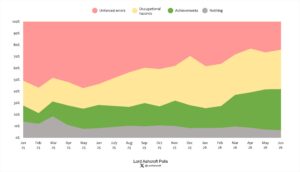
The first chapter, to around May 2025, is dominated by unforced errors. These are also the plurality right up to the end of 2025. By the time the writing was on the wall in early 2026, the story of the government had been one of avoidable mistakes rather than the occupational hazards of modern government. Achievements do not comprise more than a quarter of the noticed actions until March 2026; their rise in the last few months was too little and too late to salvage Starmer’s premiership.
What about the second strand in the argument that Britain is ungovernable: that the public has unreasonable expectations about the speed of change? Earlier this month we asked people whether they believed real progress on the country’s problems could be made in a couple of years with the right policies, would take at least a full government term, at least ten years, or if the problems ran so deep that they were beyond fixing. The chart below shows how these responses break down among people currently intending to vote for each of the five largest parties; it also shows the distribution of opinions among people who are not likely to vote for anyone.
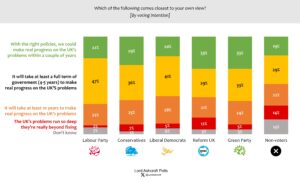
The most significant thing about this chart is how little views on this question vary between parties. Populist party supporters are more likely to believe that quick progress is possible, but even then, only one in three Green or Reform voters expect to see real change within a couple of years. A clear majority (the yellow and orange bars) of supporters of each major party think that real progress will take more than two years; a different clear majority (the green and yellow bars) believe that a government should be able to achieve real progress in a full term.
If we can take this at face value, this suggests that most people would not have expected to see major progress by the time Starmer resigned (although people might be less patient in practice than they say they are).
In January 2025, we asked people whether they thought the Labour government was making progress and achieving good things; had yet to achieve much but they were giving them the benefit of the doubt; or wasn’t going to achieve anything good and they wanted them out as soon as possible. At that time, 41 per cent of people were giving the government the benefit of the doubt and a further ten per cent believed that the government was making progress. Thirty-eight per cent felt that the government wasn’t going to achieve anything. When we asked the same question a year later, these figures were 31 per cent, 10 per cent and 48 per cent, respectively.
This is striking: one in four of those who started 2025 willing to give Starmer the benefit of the doubt began 2026 having concluded that they’d seen enough to know they wanted the government out. The following month, more agreed that the government had no direction (46 per cent) than it had the right direction (28 per cent) or the wrong direction (15 per cent) combined. Seen in this way, and against the background of a 2025 dominated by unforced errors, the criticism was not that the government had failed to reach its destination; it was that the government didn’t seem to know what the destination was, let alone how to get there.
Finally, what about the idea that voters are under the illusion that the government can spend more on public services without raising taxes? Labour certainly did little to dispel this notion in the 2024 election campaign, but is the wider argument well founded?
We can discern some clues by looking at voters who hold all three of the following views: that the incoming Labour PM should stick to the 2024 manifesto promises not to increase income tax, VAT or National Insurance; that it is more important to spend more on public services than to cut taxes, borrowing or other public spending; and that austerity is a way of protecting the well-off at the expense of the less well-off, rather than just meaning the country not spending more than it can afford. In other words, people who want higher spending on public services but will not accept it being paid for by increases in the main taxes or spending cuts elsewhere.
In our poll, 17 per cent of people hold these views, but it is not just a question of numbers. If they are mostly dedicated non-voters, they are much less important for a governing coalition. However, if they are largely the kind of swing voters any government needs to stay in power, then any electoral coalition is built on sand. In fact, neither is true: these views are held by 17% of voters and non-voters alike. The chart below illustrates current voting intention among people holding these views.
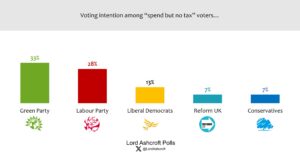
Perhaps not surprisingly, such voters are overwhelmingly in the left bloc of British politics. If governing coalitions are unstable because they cannot match their voters’ expectations, it is a bigger problem for those built around the left.
Starmer’s defenders sometimes argue that he is the victim of voters’ unwillingness to show any patience or accept tough choices. Yet his political downfall is attributable to neither of those, but to avoidable mistakes. In the end, his premiership was a demonstration of bad governance, not of an ungovernable country.
There are lessons in this, both for our new PM and the parties currently in opposition. Some of Starmer’s unforced errors can be traced back to a manifesto which dodged difficult choices, meaning the government came to office with neither a clear direction nor any clarity as to the change voters had given their blessing to. Those same manifesto pledges largely tie Burnham’s hands: 54 per cent of people, and 44 per cent of current Labour voters, expect him to adhere to the 2024 promises on tax. Even if he can avoid the unforced errors and communicate a plan in the way his predecessor could not, he will soon reach the next obstacle – that Labour doesn’t have a mandate to make the sort of tough choices the country needs if economic growth does not allow the government to have its cake and eat it.