My latest polling looks at the potential fallout from the local elections, the worst things the Labour government has done,whether civil servants should follow rules or do what elected politicians tell them, who if anyone should get help with energy bills, whether Farage is like Trump, and which public service workers should (and shouldn’t) have the right to strike.
Starmer, Badenoch and the local elections
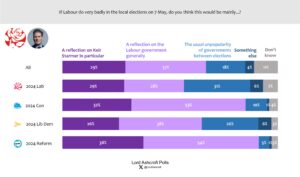
Fewer than one in five thought that if Labour do badly in the local elections on 7 May this would be down to the usual unpopularity of governments between elections. A clear majority thought it would be a reflection on the Labour government generally or Keir Starmer in particular. A majority of 2024 Labour voters also said it would be down to Starmer or Labour in general, and were evenly divided between the two.
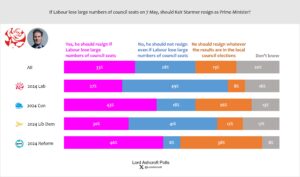
One in three, including more than a quarter (of 2024 Labour voters, said Starmer should resign if Labour lose large numbers of council seats. Just under one in five said he should resign whatever the local election results. Fewer than half of 2024 Labour voters said Starmer should not resign if Labour lose large numbers of seats.
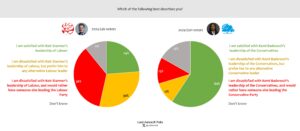
Just under a quarter of 2024 Labour voters said they were satisfied with Keir Starmer’s leadership of the Labour party, compared to six in ten 2024 Tories who were satisfied with Kemi Badenoch’s leadership of the Conservatives. Thirty-six per cent of 2024 Labour voters said they were dissatisfied with Starmer and would rather have a different Labour leader, compared to 13 per cent of 2024 Conservatives who said the same of Badenoch and the Tories. Voters as a whole were twice as likely to say they wanted a new Labour leader than a new Conservative leader.
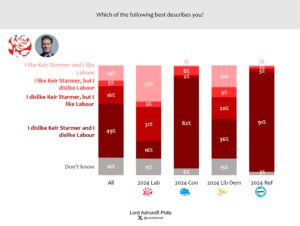
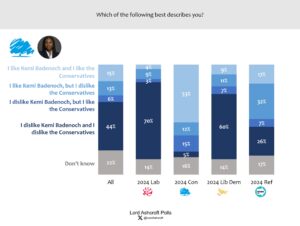
Voters were similarly likely to say they liked both Starmer and Labour as to say they liked both Badenoch and the Conservatives, and to say they disliked both party and leader. However, while they were more than three times as likely to say they liked Labour but not Starmer as to like Starmer but not Labour, they were more than twice as likely to say they liked Badenoch but not the Conservatives as to like the Conservatives but not Badenoch.
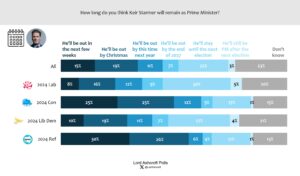
Only a quarter of voters thought Keir Starmer would still be PM at the next election, including only 3 per cent (and only 5 per cent of 2025 Labour voters) who thought he would still be in office after the election. Just over one third thought he would leave by this Christmas, including 15 per cent who thought he would go in the next few weeks, and just under half thought he would be gone by this time next year. Just under a quarter of 2024 Labour voters thought he would be out of office by Christmas, and 36 per cent by this time next year.
The worst things Labour have done
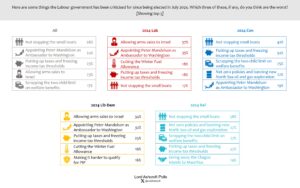
Given a list of things the Labour government has been criticised for since being elected in 2024, not stopping the small boats was chosen as the worst by 28 per cent, with appointing Peter Mandelson second on 24 per cent. Putting up taxes and allowing arms sales to Israel were close behind on 23 per cent.
For 2024 Labour and Lib Dem voters, appointing Peter Mandelson was the second worst thing after allowing arms sales to Israel. For 2024 Conservatives, the Mandelson appointment was fifth after not stopping small boats, raising taxes, scrapping the two-child benefit cap and net zero policies. For 2024 Reform voters, the Mandelson appointment was equal sixth (with releasing prisoners early and seeking alignment with EU regulations) after not stopping the boats, raising taxes, scrapping the two-child benefit cap, net zero policies, proposing mandatory digital ID and giving away the Chagos Islands.
Civil servants, politicians and rules
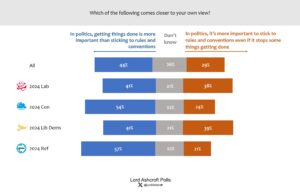
By a 15-point margin, voters were more likely to agree that getting things done was more important to sticking to rules and conventions than that it was more important to stick to rules and conventions even if it stops some things getting done. However, every group was less likely to agree with the first statement than when we asked the same question last September. The biggest fall was among 2024 Reform UK voters: in this month’s survey, 57 per cent said getting things done was more important than sticking to the rules, compared to 71 per cent last September.
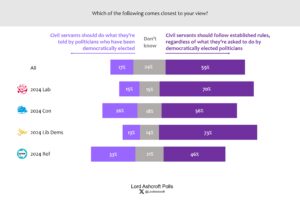
A majority said civil servants should follow established rules regardless of what democratically elected politicians asked them to do; only 17 per cent said they should do what they are told by elected politicians. All parties’ 2024 voters preferred civil servants to follow established rules, by margins of between 13 points (Reform) and 60 points (Lib Dem).
Government help with energy bills
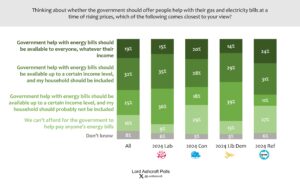
Just under one in five thought government help with energy bills should be available to everyone, while a further one in three thought help should be available up to a certain income level and that they should be included – a total of 51 per cent.
A quarter thought help should be means tested and they should probably not be included, while a further 16 per cent said we cannot afford for the government to help pay anyone’s energy bills – a total of 41 per cent.
Trump and Farage
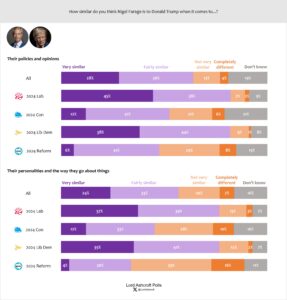
Just under two thirds of voters thought Nigel Farage was very or fairly similar to Donald Trump when it came to their policies and opinions. Most parties’ supporters thought this by a wide margin, and 2024 Reform voters did so by 47 per cent to 37 per cent.
By a smaller majority, voters as a whole thought the two were similar in terms of their policies and the way they went about things – though 2024 Reform voters disagreed with this by 55 per cent to 34 per cent.
Strikes in public services
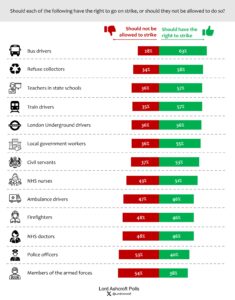
Overall, voters were more likely than not to support the right to strike for bus drivers, refuse collectors, train drivers, teachers, London Underground drivers, local government workers, civil servants and NHS nurses. They were more likely than not to oppose the right to strike for ambulance drivers, NHS doctors, firefighters, police officers and members of the armed forces.
A majority of 2024 Labour voters said every group (including the armed forces) should have the right to strike. Majorities of 2024 Conservatives said every group should not be allowed to strike (except bus drivers, though they still opposed their right to strike by 48% to 44%). Reform UK voters were more likely to oppose than support the right to strike for all groups except refuse collectors and bus drivers. In every case, however, 2024 Reform voters were more likely to support the right to strike than 2024 Conservatives.
The political map
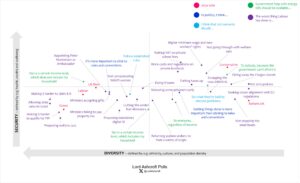
Our political map shows how different issues, attributes, personalities and opinions interact with one another. Each point shows where we are most likely to find people with that characteristic or opinion; the closer the plot points are to each other the more closely related they are. Here we see how different parts of the electorate rate the worst things the Labour government has done since 2024: the failing to implement welfare cuts, tax rises and higher costs for employers and landlords were most likely to be mentioned in the Conservative-leaning top-right quadrant, while proposing welfare cuts in the first place, making it harder to qualify for PIP and allowing arms sales to Israel were most likely to be chosen in the Green-leaning bottom left. Releasing prisoners and failing to stop the boats were most often selected in the Reform-leaning bottom right – where people were also the most likely to think civil servants should follow instructions from elected politicians rather than established rules. We can also see how different parts of the electorate considered the question of who should get government help with energy bills – everyone, no-one, or only those up to a certain income threshold (and whether or not they should be inside it).
The economy
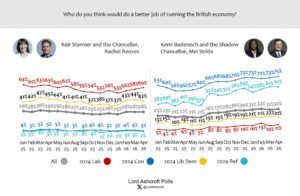
Asked who would do the better job running the economy, voters chose Kemi Badenoch and Mel Stride over Keir Starmer and Rachel Reeves by a 4-point margin; 40 per cent said “don’t know”. Six in ten 2024 Labour voters named the Labour team; three quarters of 2024 Conservatives chose the Tory team.
Best and most likely PM and the next election
In a head-to-head question, Starmer led Badenoch by two points as the better PM, with 66 per cent of 2024 Labour voters choosing Starmer and 71 per cent of 2024 Conservatives naming Badenoch. Those who voted Reform UK in 2024 said they preferred Badenoch to Starmer by a 57-point margin.
Given a choice between Starmer and Farage, voters as a whole chose Starmer by a 17-point margin. 2024 Conservatives chose Farage over Starmer by 48 per cent to 19 per cent, while 2024 Labour voters chose Starmer by 77 per cent to 8 per cent. Lib Dems chose Starmer by a 60-point margin, and Green voters did so by 58 points.
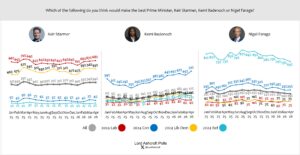
Offered a choice between Starmer, Badenoch and Farage, voters chose Starmer over Farage by a 15-point margin, with Badenoch close behind in third place. 2024 Conservative voters preferred Badenoch over Farage by a 26-point margin. Just over two thirds of 2024 Labour voters preferred Starmer.
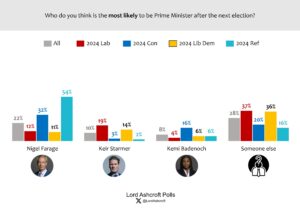
Nigel Farage was thought the most likely person to be PM after the next election, with 22 per cent naming him as the most likely candidate. Only one in ten thought Starmer would still be in the job and 8 per cent named Badenoch. Nearly three in ten thought someone other than these three would be PM. Nearly seven in ten of those currently intending to vote Reform thought Farage would be PM, compared to 39 per cent of current Labour leaners who thought Starmer would be PM and a quarter of current Conservative supporters who thought Badenoch would have the job.
When we asked how likely people were to end up voting for each party at the next election on a scale from zero to 100, those who voted Labour in 2024 put their chances of doing so again at the next election at an average of 45/100. They put their likelihood of voting Green at 31/100. Those who switched to Labour in 2024 put their chances of voting for the party again next time at 34/100, and those who switched from the Conservatives to Labour in 2024 put their chances of voting Labour again next time at an average of 25/100. Looking at those more likely than not to vote for a particular party (those whose highest likelihood of voting for one party was at least 50/100), we find Reform UK on 21%, the Conservatives and Greens each on 20%, Labour on 18%, the Lib Dems on 11% and Others on 10%.