My latest focus groups took place in Leeds, Halesowen and Solihull, where we heard from uncommitted voters about their views on the early weeks of Andy Burnham, and their hopes and hesitations about Labour’s main opponents.
Participants tended to have a favourable view of the prime minister, describing him as likeable, personable, relatable, down-to-earth and with more backbone than his predecessor: “I think he could sit around this table and have a conversation with us, but I don’t think Keir Starmer ever could;” “He’s got a bit of grit about him. I think he’ll challenge the right people. I don’t think he’ll kowtow to the Americans or the Israelis as quickly as Starmer did;” “He’s not a Sir. He seems like a real person;” “When the Stourbridge fires happened, he was straight up here. And that to me meant a lot;” “Silly things like that prank phone call from America. Starmer would have been like, technical blah blah, hiding behind stuff, but Burnham was like, yeah, it happens.”
He was playing his guitar, singing a Smiths song, visiting Ukrainian soldiers. But I don’t know if there’s any change with their policies
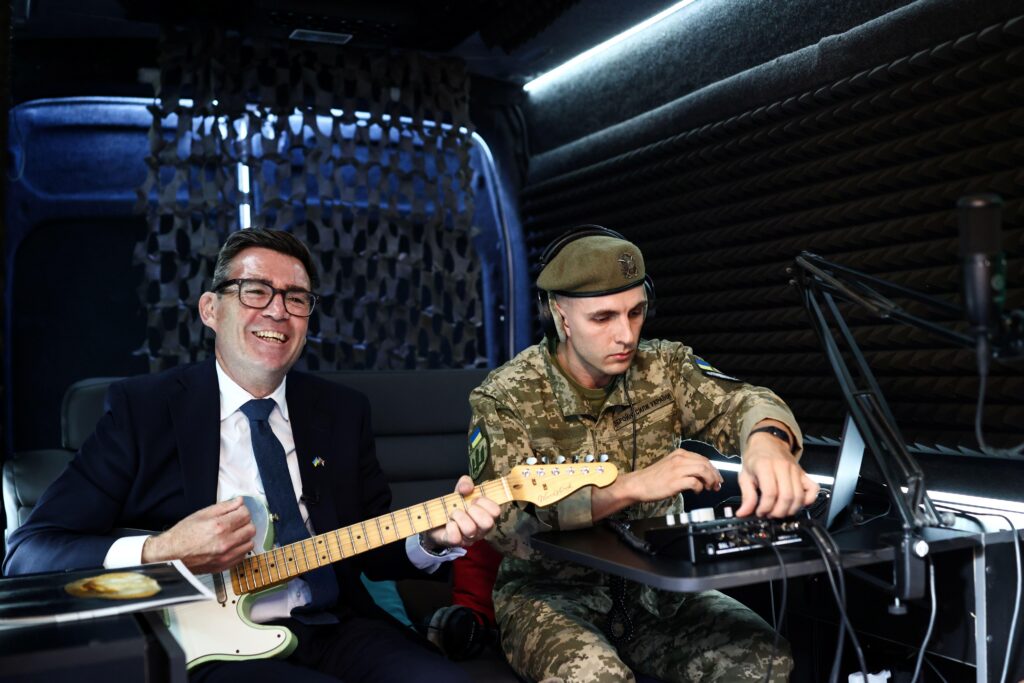
Many had noticed more about what they saw as the performative side of the Burnham premiership than the business end: “He was playing his guitar, singing a Smiths song, visiting Ukrainian soldiers. But I don’t know if there’s any change with their policies.” Even so, participants between them recalled a long list of announcements since Burnham took office, including action on homelessness, energy bills, bus fares, free bus travel all day for disabled people, mental health centres, No10 North (“it seems like he wants to move everything to Manchester”), a potential change of approach to North Sea oil and gas drilling, business rate relief for pubs, clubs and live music venues, extended free school meal provision, and intervening over early release of killers of PC Andrew Harper (“I was quite impressed with that because Keir Starmer was completely immune to such things”).
His main policy is ‘I’m going to make buses cheap’. It’s not going to keep people’s lights on
However, there remained a very widespread view that Burnham had focused on relatively small issues and had yet to tackle bigger concerns like immigration, small boats, jobs, the NHS, the cost of living and the benefits system – or to explain how he planned to do so: “I think he needs to realise he’s not running Manchester. It’s a bigger stage. His main policy is ‘I’m going to make buses cheap’. It’s not going to keep people’s lights on;” “It’s obvious that he’s just going for very popular things to pick off, like when he was telling us he was saving money on our bills and it turned out to be nothing. It’s clickbaity-type politics;” “I think the time to judge is when something happens and he has to make critical decisions. That’s when we’ll be able to see whether he swims or sinks.” Several noted that the October Budget would reveal his true intentions.
They want to scatter the illegal immigrants all through the country and create HMOs everywhere
To the extent that people had noticed any action on migration, they were not impressed: “They’re giving them leaflets to basically say ‘don’t rape women. Do you know that child abuse is illegal?’ It’s too little, too late;” “He’s doing a lot of virtue signalling. He stood by a slashed dinghy to show that he’s going to be stopping the boats, which is a load of nonsense;” “They want to scatter the illegal immigrants all through the country and create HMOs everywhere.”
Some welcomed the early actions, arguing that the small things would add up and at least marked a change of sorts: “At least it’s going in the right direction. Before you had Rachel Reeves who just kept taxing, taxing, taxing. The fuel thing isn’t going to change the world, but these little things will accumulate.” This was not a universal view: “It’s the big things we need!” “We’re impatient as a country, aren’t we?” “Is it impatient, or is it desperate?”
I think the intention is to sell it as new. But it’s not in reality. It’s just the same
Voters from all backgrounds tended to feel that the Burnham takeover represented another chapter in the story of the 2024 Labour government, rather than a complete change: “I think the intention is to sell it as new. But it’s not in reality. It’s just the same.” Accordingly, though some still disliked the way Burnham had achieved office, there was very little appetite for a general election – either because it would be a distraction from what needs doing, or because the outcome might be a change for the worse: “It would be like saying ‘well, we haven’t got a clue’. It’ll be a distraction. I want someone to say ‘I’m going to sort of find a way through this’’;” “You’ve got the seat, do something with it. Impress us;” “They’re neck and neck, so you’re going to end up with no-one in power and the country is going to be in even more of a state than it is now;” “I’m personally terrified of the choice the UK would make, with a political party becoming really popular among people who are fed lies and not educated about it.”
This did not absolve him of the need to set out a clear plan, however: “He didn’t have to get any votes, so he didn’t have to set out in black and white what he was going to offer. I’m not bothered about an election, but show us what your plan is, at least. Then we can see if you achieve any of it.”
I’m interested in some of their policies. It’s the people representing them that I have the issue with
With Reform UK’s conference taking place in Birmingham this week, what does the party need to do to keep its momentum and show itself to be a convincing potential government? Several participants who had voted Conservative or Labour in 2024 said they liked the party’s stance on issues including migration, benefits and early prisoner release, and welcomed an alternative to the established parties that seemed to respect rather than disdain working-class opinion.
However, they had a number of reservations about Reform, which tended to fall into two main categories. One was that their approach was too harsh or extreme, even if they had the right priorities, or that the party or individuals connected with it sometimes came across as racist or divisive: “I like some of the policies, but I’m scared if it goes to far. And I heard they want to get rid of the NHS, but I don’t know if that’s just a rumour;” “I’m interested in some of their policies. It’s the people representing them that I have the issue with;” “We don’t want to be turning against each other as people, turning one religion against another. There’s enough of that going on in the world. We want to bring people together rather than separating them;” “When people have been racist, when people have been misogynistic, they’ve said ‘OK’ and carried on. So how do you see any representation, any inclusivity?”
They want to stop this. They want to stop that. I’ve not heard a policy that’s about building, encouraging, developing
The other main concern was whether the party had credible policies, especially on issues other than migration: “I like their stance on illegal immigration and that’s why I’m in favour of Reform. But you don’t hear a lot else. That’s the thing;” “You take away the boats, and what have they got to offer?” “Their policies are all negative. They want to stop this. They want to stop that. I’ve not heard a policy that’s about building, encouraging, developing;” “They’ve got no experience of presenting a costed budget and things like that. I think there was talk at one point of getting the income tax rate down to ten per cent. Fantastic. Please do. At the same time, you’re talking about a massive gap in funding. How are you going to pay for that?”
He said ‘no-one cares’. Actually, people do care about this stuff
The groups also debated the role of Nigel Farage – with some finding him an attraction and others an obstacle to supporting the party. In particular, they were divided over his £5m gift from Christopher Harborne. Supporters argued that the money was given when Farage was outside politics, that the gift was no fishier than anything that happens in other parties, that the media had blown it out of proportion, or that other things mattered more: “I don’t really care an awful lot. All the parties are corrupt in some way. Pretty much every week you’re hearing something. Look at Angela Rayner;” “Look at the Farage £5 million compared to Andy Burnham being put in as prime minister that no-one voted for;” “The media are always ‘bang bang bang’. That’s what they did to Boris. I was no Boris fan, but they drove him out over that bloody piece of cake;” “It’s not ideal, is it? But there are much bigger things at play right now, and immigration reform is the biggest without question.”
However, some who were otherwise interested in what Reform had to say were doubtful about Farage’s approach to the issue and what it might say about him: “I saw him being interviewed about it and he said ‘no-one cares. No-one cares’. And I really didn’t like the way he came across. Actually, people do care about this stuff. He was quite aggressive and I thought that didn’t do him a lot of good. It certainly didn’t with me.”
Kemi is speaking well at the moment, but I’m annoyed with the Conservatives. They had a chance and they blew it
Many in the groups spoke positively about Kemi Badenoch, saying they saw her as strong, confident, sensible, sharp and funny. However, many of these said they were far from convinced that the Conservative Party more broadly had changed since it was ejected from government, and felt it had a long way to go to recover its credibility: “Kemi is speaking well at the moment. But I’m annoyed with the Conservatives. They had a chance and they blew it;” “The Tories are more palatable now with Badenoch in charge. But it would probably just be more of the same;” “She’s saying the right things, but it’s also the backbenchers and the whole party. So you just think, you’re probably a good one, but the rest of you aren’t;” “You could see what the problems were years ago, you could see them getting worse. We pay more in benefits than we get in taxes. She says it’s a problem now – it was a problem ten years ago and they did nothing about it.”
Some felt that Badenoch was sometimes tempted into populist positions or opposition for its own sake: “She’s focused very hard on the culture war and social topics, and I don’t think that is why people largely vote Conservative. People vote Conservative for the sense of fiscal responsibility and that they would make hard decisions;” “She’s kind of on the defensive and reactive as opposed to proactive. I think she’s chasing a lot of what Reform say;” “She’s the coulda woulda shoulda woman. She’s always saying, ‘he should have done this, we would have done that’. She just deflects and puts them down. I feel like she needs her own identity.”
Even so, a number of our uncommitted participants said they were cautiously willing to give the Conservatives a hearing: “She seems to have conviction and stand by what she says. But you can’t tell from a thirty-second video. It all depends on what policies they put out;” “We’ve been waiting all these years for decent leaders and now we’ve got two, for Labour and Conservative. Let’s see what you’re about, let’s see what you can do for us.
Something flamboyant, so people notice. He needs to be validated. He needs to be accepted
Finally – with the change of seasons – if Andy Burnham were a contestant on Strictly Come Dancing, which dance would he choose? “The paso doble, because it has a strong personality and it tells a story;” “The salsa or tango. Something flamboyant, so people notice. He needs to be validated. He needs to be accepted.”
How about Nigel Farage? “The funky chicken, because that’s what he is. It’s all performance;” “He’d dance to Don’t Stop Me Now. Or Smooth Criminal;” “Or Rule Britannia;” “The Charleston or something. He can be quite fun;” “In a tux with an unbuttoned silk shirt. Or an England top;” “He’d turn up late and blame Kemi Badenoch. Or immigration.”
What would Kemi Badenoch do? “Something like a foxtrot or a waltz, proper and elegant. She holds herself well;” “It would be very regimented, very Kemi. ‘Do not move your hand from my hip until I say so. You are not leading. I am leading’;” “She means business when you look at her. I can see her when it all goes black and they’ve got the white light shining down and it’s very dramatic. It might be a lift but her face would remain stern;” “I’d like it to be something really fun and joyous like a samba or the tango. She’s very serious. I’d love to see a different side.”