My latest poll looks in detail at early impressions of Andy Burnham as prime minister: whose side is he on, does he have a plan, what do people make of his ideas, and where should the money come from?
What have people noticed – and who has noticed what?
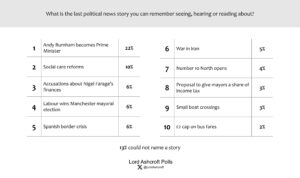
While Andy Burnham becoming prime minister was unsurprisingly the most recalled political story, it was not the only one to be mentioned when we asked what news people could remember. Burnham policies on social care reforms, Number 10 North, giving mayors a share of income tax receipts and the bus fare cap also made the top ten, as did Nigel Farage’s finances, the Manchester mayoral election, the Ceuta crisis and the conflict in Iran.
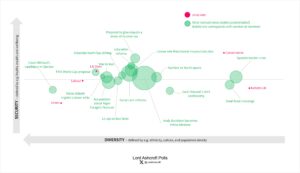
Our political map shows which stories were most likely to be mentioned by which kinds of voters. Stories about Burnham policies tended to be most noticed by those on the left-hand side of the map, as did news about Farage’s finances and the candidacy of Count Binface in Clacton. Small boat crossings, the Spanish border and the Zack Polanski t-shirt controversy were most likely to be mentioned by those towards Conservative and Reform UK territory.
Is he on my side?
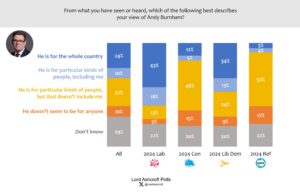
Just under a quarter said they thought Andy Burnham was for the whole country, while a further one in ten thought he was for particular kinds of people, including them. More than six in ten Labour voters thought he was for them, either as part of the whole country or the kind of people Burnham is for. Just over a quarter, including around half of 2024 Conservative and Reform voters, said he seems to be for particular kinds of people, but that this doesn’t include them.
Is Burnham an upgrade?
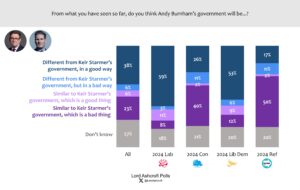
Just under four in ten said they thought Burnham’s government would be different from Keir Starmer’s in a good way. This included majorities of 2024 Labour and Lib Dem voters, and more than a quarter of 2024 Conservatives. Half of 2024 Reform voters and 40% of 2024 Tories thought it would be similar to Starmer’s, and this would be a bad thing.
Does he have a plan?
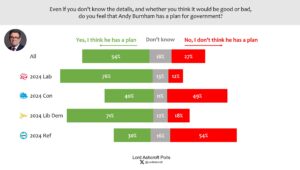
A majority of voters, including three quarters of 2024 Labour voters and 4 in 10 Tories, said they thought Burnham had a plan for government, whether or not they knew the details or thought it would be good.
Burnham policies: desirable and affordable?
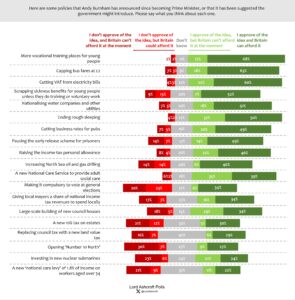
We asked whether people approved of nineteen policy ideas announced or suggested since Burnham because prime minister, and whether or not Britain can afford them at the moment. Majorities said six of them (more vocational training, capping bus fares, cutting VAT from electricity bills, scrapping sickness benefits for young people unless they do training or voluntary work, nationalising water and ending rough sleeping) were both welcome and affordable. A new National Care Service was the most likely to be approved of but thought unaffordable.
Tax, spending and the economy
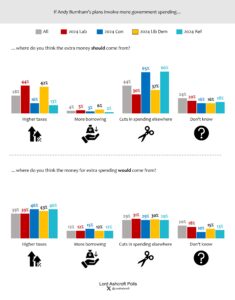
Fewer than three in ten thought the money for any extra government spending should come from higher taxes, but 39 per cent thought this would be the case in practice. Only four in a hundred thought it should come from extra borrowing, but 12 per cent thought this would be most likely. Nearly half, including two thirds of 2024 Tory and Reform voters, thought any new spending should come from cuts elsewhere, but only 29 per cent thought this would happen in practice.
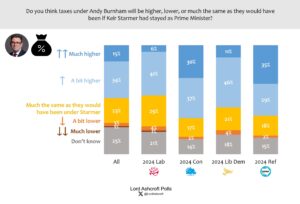
Just under half, including a majority of Conservative and Reform voters and 47 per cent of 2024 Labour voters, said they thought taxes would be higher under Burnham than they would have been had Starmer remained as PM. Just under a quarter said they would probably be much the same. Only four per cent thought taxes would be lower under Burnham.
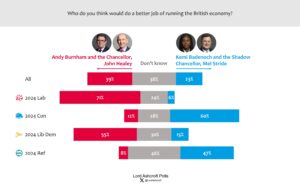
Asked who would do the better job running the economy, 39 per cent chose Burnham and the chancellor, John Healey, compared to 23 per cent who named Kemi Badenoch and Mel Stride, a lead of 16 points. Badenoch and Stride had led Starmer and Reeves consistently in the last few months of Starmer’s premiership.
Do we need an election?
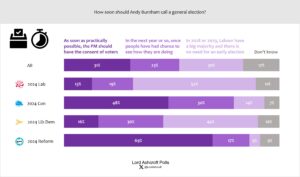
Just over three in ten said there should be a general election as soon as practically possible, compared to 40 per cent who said this shortly before Burnham became PM last month – though a majority still say they would like an election within a year. The proportion of 2024 Conservative voters demanding an early election has fallen from 62 per cent to 48 per cent, though the proportion of Reform UK voters doing so has dropped just one point to 69 per cent.
Preferred coalition
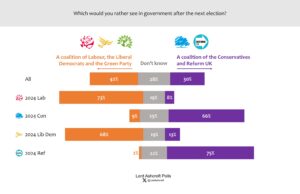
Forty-two per cent said they would prefer to see a coalition between Labour, the Lib Dems and the Greens after the next election, while 30 per cent chose a Conservative-Reform coalition. Only just under two thirds of current Tory leaners said they would prefer a Conservative-Reform government (with 28 per cent of them saying “don’t know”), compared to 81 per cent of likely Reform voters. At the end of February, voters preferred the left-wing coalition by a smaller 10-point margin. At that time, more than seven in ten likely Conservative voters said they would prefer a coalition with Reform.
Best and most likely prime minister
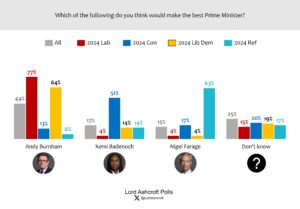
Offered a choice between Burnham, Badenoch and Farage, voters chose Burnham over Badenoch by a 27-point margin (up from 18 point last month, and a 14-point lead for Starmer in June), with Farage third on 15 per cent. Just under eight in ten Labour voters preferred Burnham (compared to 65 per cent who preferred Starmer in June).
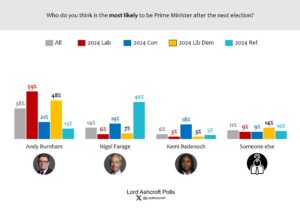
Andy Burnham remains the leader voters consider most likely to be PM after the next general election, named by 38 per cent (up from 33 per cent last month). Fourteen per cent named Farage (down from 27 per cent in June). Fifty eight per cent of those currently intending to vote Reform thought Farage would be PM (compared to 74 per cent in June), while three quarters of Labour leaners expect Burnham to be PM, up from two thirds last month).
The political map
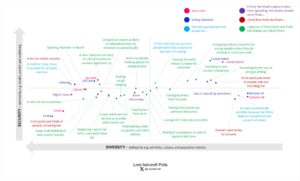
As above, our political map shows how different issues, attributes, personalities and opinions interact with one another. Each point shows where we are most likely to find people with that characteristic or opinion; the closer the plot points are to each other the more closely related they are. Here we see how different kinds of voters see the debate over an early election, whether Burnham is for the whole country or particular groups of people, where the money to finance any extra government spending should come from, and those where various Burnham policy ideas find voters saying they both approve of the idea and think it is affordable.
Next general election
Unlike most pollsters, I ask how likely people think they are to vote for each party at the next election on a scale from zero to one hundred, rather than which they would pick in a hypothetical election tomorrow. Looking at those more likely than not to vote for a particular party (those whose highest likelihood of voting for one party was at least 50/100), and weighted by likelihood to turn out and vote, this implies vote shares of Labour 27 per cent, Conservative 23 per cent, Reform UK 18 per cent, Green 15 per cent, Lib Dems 8 per cent, Others 9 per cent.