Much has changed since we last looked at the idea of an alliance between Reform UK and the Conservatives. It was, for one thing, a whole prime minister ago (admittedly not as great a measure of political time as it once was), and the fortunes of several parties look different. Is the same true for the prospects of a united right?
A year ago, with a consistent ten-point poll lead and a divided opposition, Nigel Farage could credibly claim that he was going to win the next election and form a majority government with no help from anyone else. That lead has disappeared, and as we saw in Gorton and Denton, Caerphilly and Makerfield, the party’s opponents are willing to vote tactically to keep Reform out. This is not to say that a Reform majority government is impossible, but it is certainly not inevitable. Even if Labour’s Burnham bounce subsides, the damaging publicity around Reform’s finances is likely to endure.
Another factor is the removal of Keir Starmer, whose tenure was marked by a parade of unforced errors and an inability to articulate any kind of purpose: this, rather than the unpalatable but necessary decisions inherent in modern government, was the root of his unpopularity. Even allowing for the adage that elections are lost by governments rather than won by oppositions, Keir Starmer was the ideal incumbent for the Conservatives and Reform.
We might also consider recent policy announcements from the two parties, which suggest might they could find common ground in areas like net zero, welfare, defence and the European Convention on Human Rights.
All of that being the case, if Nigel Farage regarded coming to an agreement with the Conservatives as an unnecessary and avoidable risk, that is no longer the case – not because it isn’t risky, but because all options are risky. Leaders can employ a risk-averse “ming vase” strategy when blessed with double-digit polling leads, but when their party is level or slightly behind in the polls, that won’t cut it. On the Conservative side, if they would once have been the junior partner in an alliance with Reform, they would now look much more like equals. In the new political landscape, should they look at such an arrangement with new interest? When we looked at a potential Conservative-Reform alliance last September, we found it was considerably weaker than the sum of its parts. Have the changing circumstances made a united right more viable?
The starting point is that a party leader will need the support, or at least acquiescence, of their voters for any kind of deal. We found previously that Conservative voters were much more likely to oppose working with Reform: any alliance would disproportionately damage the Tories. We have analysed this again based on people’s answers to two questions: first their preference in a head-to-head between Burnham and the other party’s leader (Badenoch if they are Reform voters, Farage if they are Conservatives); second their preference for a coalition comprising Reform and the Tories or between Labour, the Lib Dems and the Greens. Based on this, we have three groups:
- Loyalists, who prefer the other right-wing party’s leader to Burnham and who prefer a Conservative-Reform coalition
- Defectors, who prefer Burnham to the other right-wing party’s leader and who do not prefer a Reform-Conservative coalition in the event of a hung parliament (they either prefer the left-wing coalition or say they don’t know)
- Waverers, who do not fall into either of these category
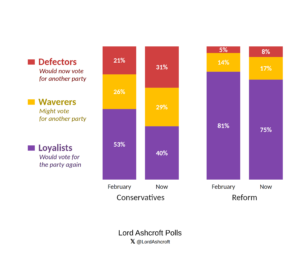
Last time, a slender majority of Conservative voters were loyalists; this majority has shrunk to a plurality of just 40 per cent. The growth has mostly come in defectors, who are up by 10 points to 31 per cent. While Reform voters remain broadly positive about such an arrangement, the proportion of loyalists among them has dropped 6 points to 75 per cent; waverers and defectors are both up slightly compared to last time. Not only do Conservative voters remain much less positive than Reform voters about a Conservative-Reform alliance, their disapproval is growing more quickly.
As the name suggests, we would expect loyalists to stick with a Reform-Conservative alliance and defectors to refuse to vote for it. If we assume that all the loyalists, half of the waverers and none of the defectors would vote for a Reform-Conservative alliance, then we would currently expect it to poll 28 per cent of the vote – much less than the share the two parties currently command between them.
Of course, the argument could be made that these defectors – of either shade of blue – are not actually going to end up supporting the party which they currently say they do. To assess this, we turn to our political map, where we have plotted the current support for each of the major parties, as well as the Reform and Conservative voters of interest. The size of the bubbles is proportional to the size of the voter group, and the closer bubbles are together, the more similar these groups are.
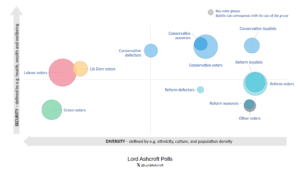
The Conservative defectors (who prefer Burnham to Farage and do not prefer a Tory-Reform coalition to a Labour-Lib Dem-Green one) are at around the “12 o’clock” point on the map, not especially close to any of the major party bubbles. However, they are still closest to the Conservative bubble and therefore have most in common with current Conservative voters. The Conservative waverer bubble overlaps with the overall Conservative bubble, suggesting that this is where the centre of gravity in Conservative opinion currently sits.
For Reform, the overall bubble and the Reform loyalist bubble largely overlap – unsurprisingly, given that three quarters of Reform voters are loyalists. However, the Reform waverer bubble overlaps with the bubble for people intending to vote for a party other than the major parties (mostly Restore Britain). Therefore, while the Conservative defectors look likely to end up voting Conservative at the next election (if there isn’t a unite the right alliance), the Reform defectors – and especially the Reform waverers – are closer to the bubble for “another party” than their own party’s bubble.
This suggests that the voters who Reform would risk losing from making a deal with the Conservatives are already at high risk of switching away from Reform (mostly to Restore Britain), whereas the Conservatives would risk losing voters who are otherwise not especially likely to switch away from their party.
We can confirm this with a simple question about whether people feel there is a political party which represents them. Overall, 49 per cent of people say that they can usually find a party which more or less represents their views, while 40 per cent say that none of the current parties really represent them. The remaining 11 per cent say they don’t know. The chart below illustrates how this question breaks down among the various groups of Conservative and Reform voters.
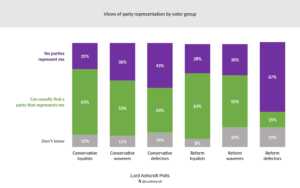
The Reform defector column here is the noteworthy: two thirds of these people – who are currently saying that they’ll vote for Reform – say that none of the British political parties represent them. That suggests that these voters will be difficult for Reform to retain. In contrast, the Conservative defectors divide evenly as to whether they feel any party represents them. Looking at the political map, one can understand it: these voters are in a “no-man’s land” between the Labour and Conservative bubbles, albeit closer to the Tories. We have written before about the challenge Badenoch faces in keeping her voter coalition together: she cannot make these centrist “12 o’clock” voters the cornerstone of policy offerings because that gives Reform a free hand on the right, but nor can she lose them.
Another question – how likely people are to vote for each party are to support each party at the next election on a scale from zero to one hundred – allows us to distinguish between committed supporters and floating voters. We can therefore derive three categories of voters for each party:
- Core voters, who say their likelihood of supporting that party is very high (75+ out of 100)
- Soft voters, whose likelihood to support is between 50 and 75
- Potential voters, who are currently intending to support a different party but who are at least slightly open (25-49) to supporting this party
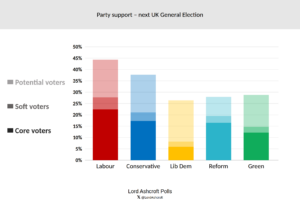
Asking about the individual parties we find Labour slightly ahead, but with the combined Reform and Conservative vote share some 13 points higher than the Labour vote share. Notably, Reform have the smallest gap between their floor and ceiling and the highest proportion of their current voters being core voters, demonstrating that they retain a highly motivated base, but have limited scope for expanding their vote share.
When we ask the same question including a Conservative-Reform alliance in place of the two parties separately we find a somewhat different picture:
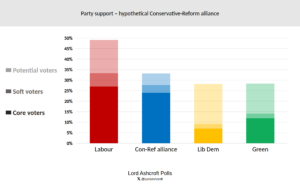
Merely because of facing a Conservative-Reform alliance, Labour’s vote share increases five points, and their ceiling also increases by five points. One might think that this is a manifestation of anti-right bloc tactical voting, but in fact only 8 per cent of these voters come from other parties on the left: 31 per cent of these new Labour voters would currently vote for the Conservatives, 29 per cent are undecided, and more than a quarter say they would not vote.
The Conservative-Reform alliance cuts Labour’s current lead from 7 points to 5 points. However, while the Reform vote share and the Conservative vote share add up to 41 per cent, the alliance only manages 28 per cent – some 13 points lower. This is even worse than a year ago, when we found that a Conservative-Reform alliance would poll 10 points less than the sum of its parts. The alliance also has a high floor and a low ceiling. Its ceiling is at 33 per cent, halfway between the Reform’s at 28 per cent and the Conservatives’ at 38 per cent. These are inauspicious numbers for a putative alliance.
If uniting the right has never been more important since we entered the era of five-party politics, it has also never been more difficult. An electoral alliance between Reform and the Conservatives would be doomed to fail, and the Conservatives have much more to lose from trying.