My latest polling looks at the Labour leadership contenders, what kind of change (if any) a new PM would bring, whether there should be a general election if Keir Starmer is replaced, whether Labour so far have been better or worse than the Conservatives, which party voters would least like to see in government, and whether Britain should rejoin the European Union.
What have people noticed? And who has noticed what?
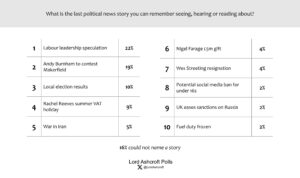
Labour leadership speculation and Andy Burnham’s candidacy in the Makerfield by-election dominated people’s recall ofrecent political news. Local election results, the Chancellor’s “great British summer of savings scheme” was next, followed by the Iran war and Christopher Harborne’s £5 million gift to Nigel Farage.
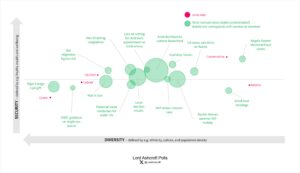
Our political map shows what kind of voters were most likely to recall which news. Stories about the Labour leadership, the Makerfield by-election and the local elections appear close to the centre of the map, showing that they were recalled by voters of all kinds. News about the Farage £5 million and ECHR guidance on single-sex spaces was most likely to be mentioned in Labour and Green-leaning territory. Stories about Angela Rayner and Russian sanctions were most likely to be recalled in Conservative-leaning territory, and small boat crossings by voters in the Reform-leaning bottom-right quadrant of the map.
The Labour government and Keir Starmer’s leadership
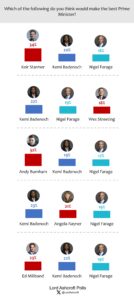
We extended our regular question on who would make the best prime minister to include Andy Burnham, Wes Streeting, Angela Rayner and Ed Miliband, pitching each against Kemi Badenoch and Nigel Farage. Badenoch was considered the best prime minister against Streeting and Rayner and Farage. She was behind against Miliband (by 1 point) and Andy Burnham (by 13 points).
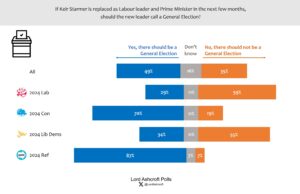
Just under half of all voters said there should be a general election if Keir Starmer is replaced as prime minister, including seven in ten Conservative voters from 2024 and 87 per cent of those who voted Reform UK. Majorities of Labour and Lib Dem voters said there should not be a general election, and Green voters were more likely to say there should not be than that there should.
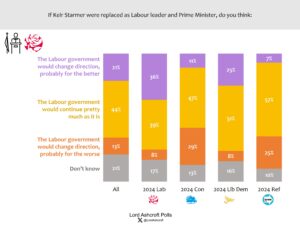
Only just over one in five voters thought the Labour government would probably change direction for the better if Starmer were replaced as PM. 2024 Labour voters were the most likely to think this. Just under half, including a majority of Reform UK voters, thought the government would continue pretty much as it is.
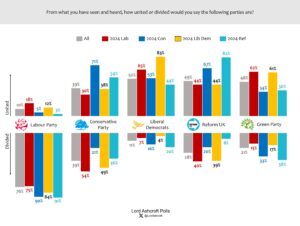
Voters said they thought the Labour party was divided rather than united by a 66-point margin (and 2024 Labour voters by a 57-point margin). The Lib Dems, Greens and Reform UK were more likely to be seen as united than divided, and voters were evenly split as to which applied to the Conservatives.
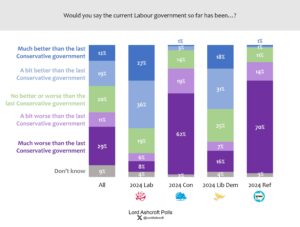
Overall, voters said the current Labour government so far had been worse than the last Conservative government by a nine-point margin. Only just over six in ten 2024 Labour voters said the current Labour government had been better, as did three in ten of those who switched from the Tories to Labour.
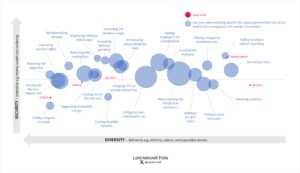
Our political map also shows which kinds of voters spontaneously recall specific things the government has done. Lifting the two-child benefit cap, raising employers’ National Insurance were named across the board, while means testing winter fuel allowance was most likely to be mentioned by those towards the right-hand side of the map. Tax rises and failed welfare reform were most likely to be named in the Conservative-leaning top right quadrant, while renters’ reform, Israel, workers’ rights and NHS waiting lists were more likely to be mentioned in the top and bottom left quadrants.
Brexit and the European Union
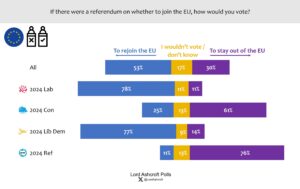
Respondents said that in a referendum they would vote to rejoin the EU by 53 per cent to 30 per cent, with another 17 per cent saying they didn’t know or wouldn’t vote. One quarter of 2024 Conservatives and 11 per cent of 2024 Reform UK voters said they would vote to rejoin. Nearly eight in ten Labour, Lib Dem and Green voters said they would vote to rejoin.
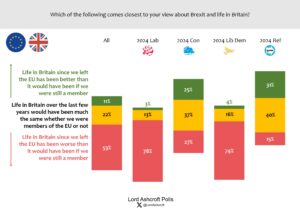
Just over half said life in Britain since we left the EU had been worse than it would have been if we were still a member, including nearly 8 in 10 Labour, Lib Dem and Green voters. Only a quarter of those who voted for Brexit in 2016 said life had been better than if we had stayed; four in ten said it would have been much the same whether we were EU members or not, and 22 per cent of them said life had been worse outside the EU.
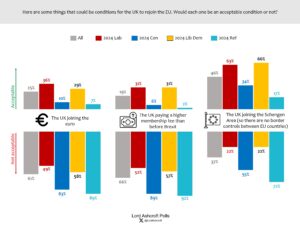
More than six in ten said that joining the euro and paying a higher membership fee would not be acceptable conditions for rejoining the EU. 2024 Labour, Lib Dem and Green voters were more likely to say both were unacceptable rather than acceptable. Around two thirds of Labour, Lib Dem and Green voters said Schengen membership was an acceptable condition, while majorities of Conservative and Reform voters disagreed.
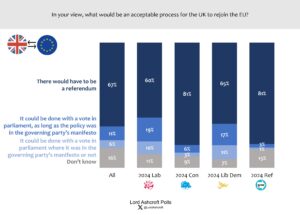
Two thirds of voters said there would have to be a referendum before Britain could rejoin the EU. This included majorities of all parties’ voters, including more than eight in ten 2024 Conservative and Reform voters.
Nigel Farage and Reform UK
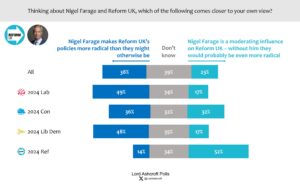
Voters as a whole were more likely to think Nigel Farage made Reform’s policies more radical than they might otherwise be, rather than that he was a moderating influence. The only exception was Reform UK voters themselves: a majority saw Farage as a moderating influence rather than a radicalising force.
The economy
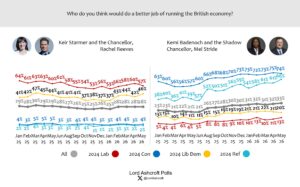
Asked who would do a better job running the economy, voters chose Kemi Badenoch and Mel Stride over Keir Starmer and Rachel Reeves by a 5-point margin. Only 57 per cent of 2024 Labour voters named the Labour team; 74 per cent of 2024 Conservatives chose the Tory team.
The political map
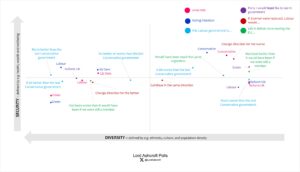
Our political map shows how different issues, attributes, personalities and opinions interact with one another. Each point shows where we are most likely to find people with that characteristic or opinion; the closer the plot points are to each other the more closely related they are. Here we see different kinds of voters view life in Britain since leaving the EU, their expectations of the Labour government if Starmer is replaced, whether the current government is better or worse than the last Conservative government, and the parties they would least like to see in office after the next election.
The next general election
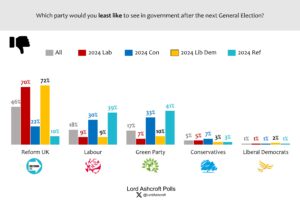
Nearly half of all voters said Reform UK were the party they would least like to see in government after the next election. Those currently leaning towards the Conservatives were evenly divided between naming Reform, Labour and the Greens. Those leaning towards Reform UK were evenly divided between naming the Greens and Labour.
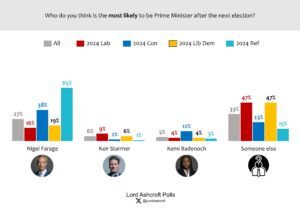
Nigel Farage was thought the most likely person to be PM after the next election, with 27 per cent naming him. Six per cent named Starmer. One in three thought someone other than these three would be PM. Just under three quarters of those currently intending to vote Reform thought Farage would be PM, compared to one in five current Labour leaners who thought Starmer would be PM and 19 per cent of current Conservative supporters who thought Badenoch would have the job.
We ask how likely people think it is that they will end up voting for each party at the next election when it comes on a scale from 0 to 100 (a different method from most pollsters, who ask people how they would vote in an election tomorrow. Full details are here). Those who voted Labour in 2024 put their chances of doing so again at the next election at an average of 45/100. They put their chances of voting Green at 25/100. Those who switched to Labour in 2024 put their chances of voting for the party again next time at 37/100, and those who switched from the Conservatives to Labour in 2024 put their chances of voting Labour again next time at an average of 26/100. Looking at those more likely than not to vote for a particular party (those whose highest likelihood of voting for one party was at least 50/100), this implies current vote shares of Reform UK 21 per cent, Conservative 21 per cent, Labour 19 per cent, Green 18 per cent, Lib Dems 11 per cent, Others 10 per cent.