This is an edited version of my presentation to the Black Sea Security Forum in Odesa
More than four years after Russia’s full-scale invasion, this year’s gathering explores the theme of the End Game – whether we are already in it, and how we could see it play out. To help set the scene, I will be presenting my latest polling from Ukraine, and from five crucial allies: Britain, the US, Germany, France and Poland. I’ll also show my latest results from Russia. If this seems a controversial idea, my reasoning is that it’s worth finding out what we can about domestic opinion and morale behind the Putin regime and – even if we take the absolute figures with a pinch of salt – the direction in which they seem to be moving.
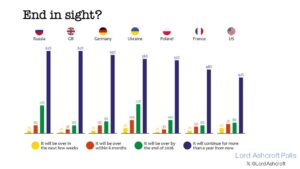
It is worth noting at the outset that while we talk about the “endgame” – and while it’s useful to look at how things might be concluded – most Ukrainians see the conflict as one of endurance and expect it to continue for at least another year. Only just over one in three think it will be over by the end of 2026. Russians are even more likely to say the war will still be going on one year from now. That view is shared by people in the five allied countries we polled – and it the number looks lower in the US, that’s because Americans are more likely to say they don’t know.
In a separate question, a clear majority of Ukrainians also said they thought the outbreak of war with Iran had pushed the end of their own conflict further away. Moreover, only one in ten said they thought Donald Trump’s involvement in negotiations had hastened the end of the war – they were more than three times as likely to think this had made the end more distant, and half said it made no difference.
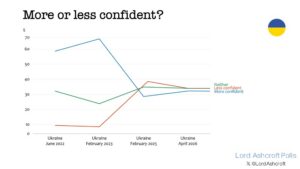
Four months into the war, I found nearly six in ten Ukrainians saying they were more confident of defeating the Russian invasion than they were when the conflict began – a figure which rose to nearly seven in ten over the following year. This has now fallen to around one in three, around the same number who say they are less confident of victory than they were when Putin’s army invaded.
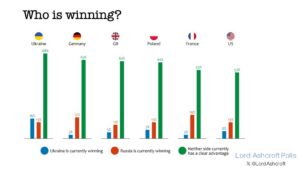
As for how things currently stand, only 16 per cent of Ukrainians say they believe they are currently winning the war, if you will forgive such a crude formulation. This is down from nearly half of those we surveyed a year into the conflict in 2023. Even so, this is more than the proportion who think Russia has the upper hand. Though Russia has experienced net territorial losses over the last year, two thirds of Ukrainians think neither side currently has a clear advantage, a figure unchanged since my previous survey just over a year ago.
In our five allied countries, majorities also agree that neither side is in an obviously stronger position. However, it is notable that in each case, the dissenting minority is more likely to think things are going Russia’s way than Ukraine’s.
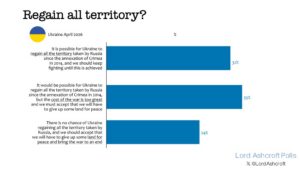
At the same time, I found fewer than one quarter of Ukrainians saying there was no chance of winning back all the territory taken by Russia since the annexation of Crimea in 2014. However, there were differing views among the majority. Around one third said it was possible to regain all Russian-occupied territory and that Ukraine should keep fighting until this was achieved. But a similar proportion said that while regaining all the lost territory was possible, the cost of the war was too great, and Ukraine must accept that it would have to give up some land for peace. It was perhaps notable that the oldest age groups were the most likely to want to keep fighting until all the invaded territory had been regained.
In a separate question, nearly three quarters of Ukrainians said they would prefer to see direct negotiations begin between diplomatic representatives of Ukraine and Russia, with only 20 per cent preferring simply to fight until Russia’s military are defeated.
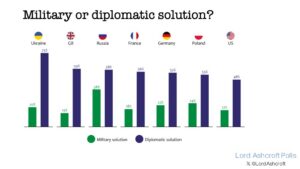
Accordingly, in a reversal of the situation in the months after the invasion when most Ukrainians expected the conflict to be settled on the battlefield, three quarters now say they expect a diplomatic rather than a military solution to the war. Expectations lean the same way in our five allied countries: Poles are the most likely to expect things to be settled militarily, but fewer than a quarter of them think this will be the outcome. Whether significantly or not, Russians are nearly twice as likely as Ukrainians to think the solution will be military rather than diplomatic – though a majority still expect the latter.
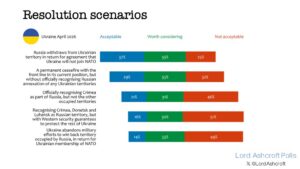
If a diplomatic solution is the expectation, what might it look like? We asked Ukrainians how they reacted to some hypothetical scenarios – however unlikely they might be. More than seven in ten said Russian withdrawal in return for an agreement that Ukraine will not join NATO was either acceptable or would be worth considering. A majority also thought it was at least worth considering a permanent ceasefire along the current front line, but without officially recognising Russian annexation of any Ukrainian territories. More divisive was the idea of recognising Crimea as part of Russia, but none of the other occupied territories. And Ukrainians were more likely than not to oppose abandoning military efforts to win back occupied territory in return for NATO membership, and recognising Crimea, Donetsk and Luhansk as Russian territory with western security guarantees to protect the rest of Ukraine.
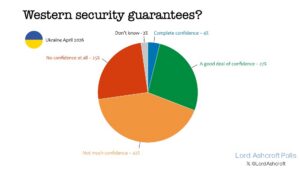
One element of Ukrainian scepticism on this last point is explained by another question. If western allies were to guarantee Ukraine’s security as part of a peace deal with Russia, but without Ukraine joining NATO, how much confidence would Ukrainians have in such a guarantee? A stunning 4 per cent said they would have complete confidence, with just over a quarter saying they would have a good deal. Not at all surprisingly given the history of such assurances, two thirds said they would have either not much confidence or no confidence at all in western security guarantees.
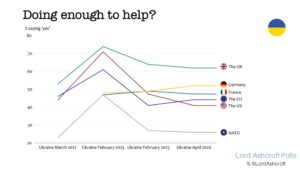
When we asked Ukrainians whether particular allies were doing enough to help, I’m pleased to say that the UK came out on top, albeit with fewer replying in the affirmative than at the peak three years ago. Indeed this was the general theme, with the US, the EU and especially NATO falling short in public estimation compared to the situation a year into the full-scale war.
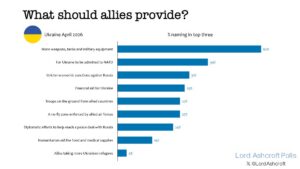
Ukrainians are also pretty clear about what they want their allies to provide. More weapons, tanks and military equipment top the list. NATO membership was second, though this was chosen by fewer than four in ten – perhaps because they think it’s an unrealistic goal or because they see it is a long-term objective rather than an immediate priority. Stricter economic sanctions, financial aid, troops on the ground and a no-fly zone all come ahead of diplomatic efforts to reach a peace deal with Russia.
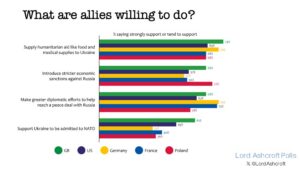
When we ask the public in our five allied countries what help they would be willing to see their governments offer Ukraine, the answers come in a rather different order. They are overwhelmingly willing to supply humanitarian aid, though this comes close to the bottom of the list for Ukrainians themselves. People in Britain and Poland were also largely willing to impose stricter sanctions against Russia, though only just over half agreed in the US, Germany and France. Diplomatic efforts to reach a peace deal were also popular, though with some scepticism in Poland. And while more than six in ten Britons said they would support Ukrainian membership of NATO, those in the US and France were more hesitant and only minorities in Germany and Poland agreed.
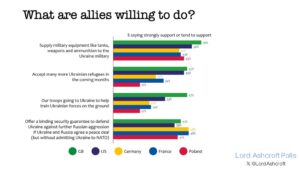
Just over half in Britain said they would be willing for the country to offer more military support, with slightly lower numbers among the other allies. There was more scepticism about the idea of accepting more Ukrainian refugees, with particular resistance in Germany and Poland. There was also lukewarm support for the idea of binding security guarantees, which of course goes hand in hand with Ukrainian opinion on what such guarantees might be worth.
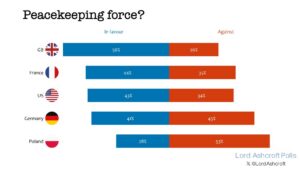
Asking specifically whether they would support sending troops to Ukraine join an international peacekeeping force in the event of a peace deal, we once again find a majority in favour in Britain, and the public more supportive than opposed in France and the US. However, the balance was slightly against in Germany, and a majority opposed the idea in Poland.
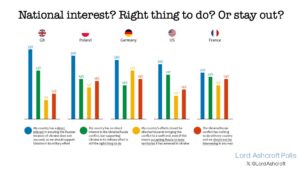
It is also instructive to ask the public in allied countries why they think they should help Ukraine, if indeed they want to do so at all. One third of respondents in Britain, falling to a quarter in the US and just over one fifth in France, say their country should support Ukraine’s military effort because their own country has a direct interest in ensuring the Russian invasion doesn’t succeed. Somewhat fewer – just under a quarter in Britain, falling to 16 per cent in Germany – say their country has no direct interest in the conflict, but that supporting Ukraine is still the right thing to do.
The remainder are split between two other propositions: that their countries’ efforts should be directed towards bringing the conflict to a swift end even if it means Russia keeping annexed territories, or that the conflict has nothing to do with them and they should not be intervening in any way. These two answers combined accounted for one in five in Britain, rising to one third in France and Poland and 42 per cent in Germany.
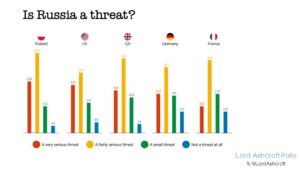
A related question is the extent to which these allied populations see Russia as a threat to their own country. Not surprisingly given their relative proximity, people in Poland are the most likely to do so, with nearly three quarters grading the threat as either very or fairly serious. Next was the UK, where two thirds said the same, perhaps with the murderous activities of Russian agents on British soil still very much in mind. Beyond that, you may or may not be surprised to see that Americans are slightly more inclined to see Russia as a threat than the Germans or French.
The question that follows is why, then, they are not therefore more eager to help Ukraine in its cause. The answer, I think, is that it depends on your disposition. We can argue that if Russia is a threat, the allies should step up efforts to defeat it. For others, it’s an equally good reason to stay well out of the way.
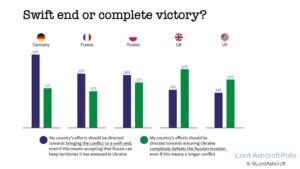
Finally on this theme of allied support, we asked people if they thought their countries’ efforts should be directed towards bringing the war to a swift end, even if that means accepting Russia keeping annexed territory – or towards ensuring Ukraine completely defeats the Russian invasion, even if this means a longer conflict.
Among the five allied countries we surveyed, only Britain and the US tended to favour aiming for complete victory, even at the expense of prolonging the war. By varying margins – five points in Poland, twelve points in France and 23 points in Germany – people elsewhere tended to prioritise an earlier end to the conflict, even at the expense of Ukrainian territory.
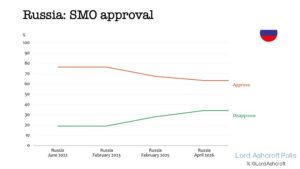
As I mentioned, I will round off with a few observations about opinion on the other side. To reiterate, I look at these numbers from my Russia survey not in terms of absolutes but in terms of trends – that is to say, how the proportions prepared to give a frank opinion to a stranger on the phone changes from one year to the next. For example, we can see here that support for the so-called Special Military Operation in Ukraine has drifted down since the invasion, with around one third of Russians prepared to say that they disapprove of the action. In a separate question we found a similar fall in agreement that the SMO in Ukraine was necessary to protect Russia’s national security.
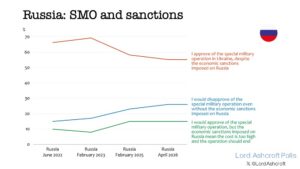
We see more scepticism when we mention the cost in terms of economic sanctions. Only just over half say they approve of the SMO despite the sanctions imposed on Russia. More than four in ten say either that they would approve of the SMO but the sanctions mean the cost is too high and the operation should end, or that they would disapprove of the SMO even without the sanctions. I also found nearly half of Russians saying that western sanctions were having a negative impact on their life, up from 38 per cent in my previous survey last year.
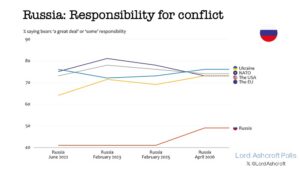
When we ask Russians who is responsible for the war, they are naturally most likely to point the finger at NATO, the US, Ukraine and the EU. Compared to last year, however, we recorded a notable rise in the numbers saying that Russia itself bears some responsibility for the conflict; just under half the population now say this.
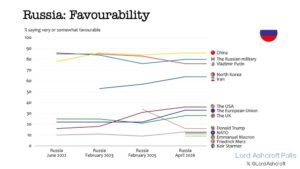
Another straw in the wind, for what it’s worth, is that the proportion of Russians saying they have a positive view of Vladimir Putin is also down, albeit to the mid-70s. Separately, we also found falling numbers willing to say they trust Russia’s current leadership to make the right decisions for the country, and that they think Putin has the best interests of ordinary Russians at heart. Favourability towards the US, the EU and the UK are slightly up on a year ago – though the opposite is true of Donald Trump.
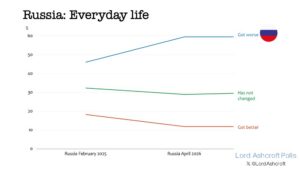
Perhaps more tangible is their view of everyday life. Only just over one in ten say this has got better over the last three years; well over half are prepared to say things have got worse.
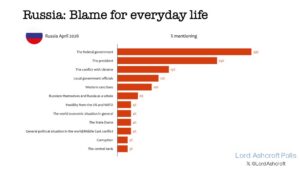
We asked those who said life was getting worse who they thought was to blame for this state of affairs, leaving them to give their own answers without prompting. Strikingly, relatively few mentioned sanctions, NATO or the west. The biggest culprits were “the federal government” and, for the braver ones prepared to spell it out, the president himself.
As I say, all this data and more will be available on my website, LordAshcroftPolls.com, later today. I hope this sketch of opinion at home and abroad will constitute food for thought as we continue the Forum’s agenda. I was pleased to see the British public confirmed as some of Ukraine’s strongest supporters. And reassuringly, despite the current direction of their government, the American people often demonstrate stronger support for Ukraine’s independence and sovereignty than some European societies. Ukraine has a great deal going for it. Despite some of the hesitations among the European public, with its extraordinary technological innovation and a battle-hardened army Ukraine is becoming a considerable military power and a vital contributor to the security of the continent.