
The following is an edited version of my presentation to the Democracy Union of Africa forum in Nairobi, Kenya, on 27 October
I’m always slightly wary of speaking to experts about their own politics on their home turf. But I’m not a complete stranger. I spent some of my formative years in Nyasaland, now Malawi, and I’ve since been back to Africa more times than I could count. I’m pleased to say I’ve invested in a number of successful African businesses and philanthropic endeavours, including here in Kenya.
Even so, this is the first time I have conducted polling on any scale in Africa, and I should say a word about the work we’ve done. Our chosen topic is “Africa and the world: challenges for the continent’s centre right”. We have polled more than 12,000 people in ten countries which between them represent more than half of Africa’s total population: Côte d’Ivoire, Egypt, Ethiopia, Ghana, Kenya, Morocco, Nigeria, South Africa, Tanzania and Uganda.
Our surveys were conducted online, with all the obvious caveats that implies where internet access is incomplete or inconsistent. This being the case, this is probably best thought of as a study of the online population of these countries, which on average is likely to be more urban and with more years of education. Nevertheless, I hope you will agree we have uncovered some important findings on what we might call leading opinion, and some of the issues that the centre right will have to grapple with now and in the future, not just in these ten countries but in Africa more widely – especially when it comes to this forum’s wider theme of navigating Africa’s strategic position in a multipolar world. Full details and all the data will be available later today on my website, LordAshcroftPolls.com.
I’ll begin, incongruously you might think, with a finding from a poll I conducted a few weeks ago in the UK.
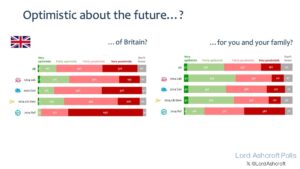
Asked how they felt about the future of Britain, three quarters said they were pessimistic. Whichever party they voted for, big majorities said the future looked bleak. People were slightly less gloomy when we asked about the future for themselves and their families, but not much: overall, only 3 in 100 said they were very optimistic about the future.
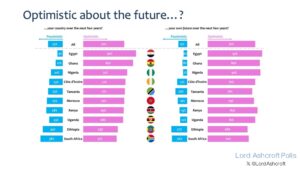
I’m happy to say that the contrast with our surveys in Africa could hardly be more stark. We found people to be overwhelmingly optimistic for the next few years, both for their country and – especially – for their own future. Even where people were least likely to be optimistic for the nation, around 7 in 10 were positive about their own prospects. This was particularly the case for younger generations: more than half of respondents up to the age of 44 described themselves as “very optimistic” about their own future.
This sense that the future is bright can be seen in other ways too. In 9 of the 10 nations we surveyed, clear majorities believed that if you worked hard it was possible to be very successful in their country no matter what your background.
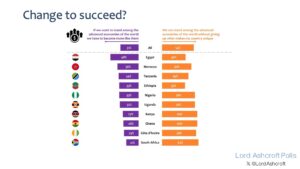
Given the contrast between this cheerful optimism and the economic, social and cultural unease that pervades much of the rest of the world, it is no surprise to see that our respondents tended to reject the idea that they needed to become more like other countries in order to succeed. Majorities in nearly all our surveys felt their country could stand among the advanced economies of the world without giving up what made them unique. Notably, younger people were on average more likely to think this than their older compatriots.
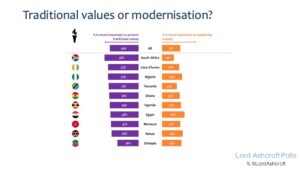
Similarly, respondents in all our countries were more likely to think it important to protect traditional values than to modernise society. In a related question, we also found respondents more likely to say that people should not be allowed to disrespect religious views than that they should be free to criticise religion even if some were offended. Indeed, we found younger people were more likely to think this than their seniors.
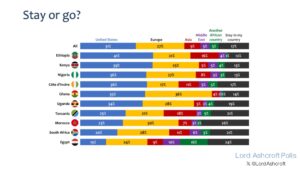
That is certainly not to say that everything is rosy and that people are content with their lot. One indicator of this is the very high proportion of respondents who said they would live and work in another country if they had the chance. The United States was the most popular potential destination, especially for respondents in Ethiopia and Kenya. Those in Ghana, Morocco and South Africa were more likely to say they would choose Europe, while Egyptians were the most likely to say they would head for another country in Africa. Overall, fewer than 1 in 5 in our survey said they would stay in their country if they had the chance to go elsewhere.
However, it’s important to see this finding in the right context. Combined with the sense of optimism we saw in our previous questions, I think it shows a sense of dynamism, frustration and impatience for the next thing, rather than despair at their own country’s prospects. So why aren’t things moving as fast as they would like? What do they think is holding progress back?
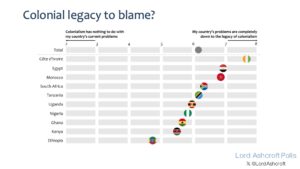
Some believe Africa’s colonial history makes it harder for them to make any kind of headway. We found people most likely to put their country’s problems down to the legacy of colonialism in Côte d’Ivoire, and that they were strikingly less likely to do so in Ethiopia, Kenya and Ghana. It was also notable that younger people were rather less likely to blame colonialism for the challenges their country faced than were their older counterparts.
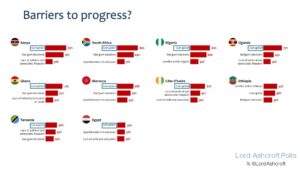
Overall, however, people were much less likely to blame the past than the present, and much more likely to think solutions were to be found at home rather than abroad. When we offered respondents a long list of factors that might be holding back progress in their country, corruption was by far the most likely to be chosen. Across the board, more than 7 in 10 named corruption as one of the three biggest barriers to progress – rising to 87% in Kenya, 86% in South Africa and 82% in Nigeria. It was seen as the biggest barrier in every country we surveyed except Ethiopia, where it was second to internal conflict.
Bad government decisions were seen as the next biggest culprit, named by more than half of respondents on average and coming second in 6 of the 10 countries we surveyed. A lack of political and democratic freedom also featured regularly in various countries’ main concerns. Not surprisingly, it came second only to corruption in Côte d’Ivoire, where the government has obstructed free and fair elections and systematically excluded key opposition figures, and in Tanzania, where Chadema has been barred from elections and its leader Tundu Lissu is in prison on bogus charges of treason.
Internal conflict, the gap between rich and poor, lack of skills and education also feature regularly in various countries’ top three issues.
Also not surprisingly, given the perceived prevalence of corruption and voters’ impatience for progress, majorities in most countries said they had little or no confidence in public institutions like the government, courts, police and public officials.
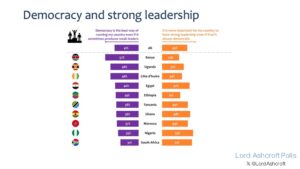
Frustration with the status quo and with the organs of the state might help to explain people’s pretty ambivalent views about democracy itself. Respondents as a whole were closely divided between thinking democracy is the best way of running the country even if it sometimes produces weak leaders, and thinking it is more important to have strong leadership even if it isn’t always democratic. In fact, Kenya was the only country in which a majority said democracy was always best, and was one of only four countries in which people were more likely than not to take this view. It was also notable that women and younger people were more likely than men and older people to prioritise strong leadership over democracy.
On the face of it, this seems quite an alarming finding. However, I don’t think we should interpret this as a wish to overthrow the system of free elections where it is established, or to do away with things like free speech, free media or an independent judiciary where they exist, and replace the whole thing with a succession of dictators.
Rather, I see a reflection of what we’ve seen in the US, and increasingly in the UK too. At a time when people are restless and frustrated and want to see change, they set less store by the conventions of politics. When leaders come along who challenge the established rules, their opponents’ instinct is to condemn their disregard for the process, failing to recognise that for many voters the process matters less than the outcome. As we see clearly with Donald Trump, and to an extent with others including Britain’s Nigel Farage Marine Le Pen of France and Italy’s Georgia Meloni, many are prepared to overlook or even applaud departures from the norms of politics if they seem more likely to get things done.
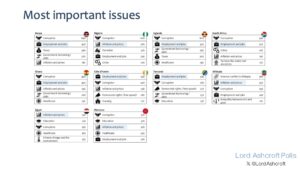
Whatever form their leadership takes, what do people want it to deal with? Not surprisingly given our earlier question, dealing with corruption tops the list. But in nearly all cases, an economic issue occupies one of the top two spots: either employment and jobs, or inflation and prices. Taxes, debt, crime, democratic rights and education also featured among the top three in different countries when we asked what were the most important issues facing their nation.
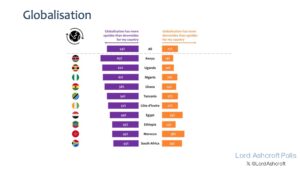
Accepting that these African voters tend to believe the answers to their countries’ challenges will be largely home grown, who are they looking to as partners for the progress they hope and expect to see?
It’s worth noting here that on average, just over half of respondents in the states we surveyed said they thought globalisation had more upsides than downsides for their country. There were considerable variations, however: while more than 6 in 10 took this view in Kenya, Uganda and Nigeria, fewer than half did so in Egypt, Ethiopia, Morocco and South Africa.
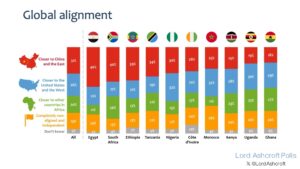
We asked people how they would like their country to be aligned in global terms – closer to China and the East, the United States and the West, other African countries, or completely non-aligned and independent.
In the answers we see a good deal of nuance and some notable variations. Those in Egypt, South Africa and Ethiopia were the most likely to say they wished to be close to China and the East, while those in Ghana, Uganda and Morocco said – albeit by smaller margins – that they would rather be aligned with the United States and the West. South Africans, Kenyans, Ugandans and Ghanaians were the most likely to prefer alignment with other countries in Africa. On average, just over 1 in 5 said they would rather be completely independent and non-aligned, with Moroccans the most likely to take this view.
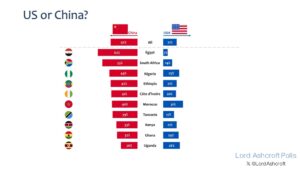
We see some more salutary and sometimes rather stark results when we narrow the question down to a choice between allying with the United States or China. Perhaps uncomfortably for many of us on the centre-right, in no country did our respondents lean more towards America. Most countries leant quite heavily towards China, and decisive majorities did so in Egypt and South Africa – by margins of 55 points and 41 points respectively.
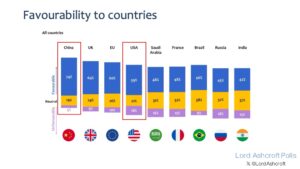
On average, nearly three quarters of all respondents said they had a very or somewhat favourable view of China, making it the most popular nation of those we asked about. At least two thirds of respondents said they had a favourable view of China in all 10 of the countries we surveyed, rising some 80% in Egypt and Nigeria.
I’m very happy to say that the United Kingdom was the second most popular country on our list, with nearly two thirds taking a positive view of our modest island.
Though the balance of opinion towards the United States was positive, only 59% overall said they had a favourable view, putting it in fourth place on our list, behind the European Union. Opinion towards the US varied much more widely than was the case with China: three quarters of Ugandans in our survey had a favourable view of the country, compared to fewer than half in Egypt and only 39% in South Africa.
We can deduce some of the reasons for the comparative popularity of the two great global rivals. President Trump is surely a factor, particularly in South Africa, where the US has cut off aid, scaled back bilateral relations and imposed higher tariffs than on any other sub-Saharan country, and where Trump has spoken of a genocide against white farmers. Further afield, as in Europe, there has always been an element which, for historical or ideological reasons, look at the US with resentment and suspicion.
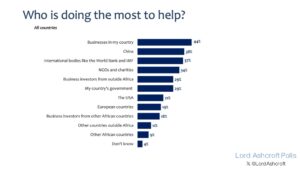
But we should also look at the other side of the equation. When we presented respondents with a long list of entities and asked which were doing the most to help development in their country, local businesses topped the list. But next came China – ahead of international bodies like the World Bank and the IMF, ahead of NGOs and charities, and well ahead of their own governments, the United States and Europe.
Whatever the worrying longer-term consequences, at a time when the US is imposing tariffs and putting up barriers to trade, people in Africa see investment from China bringing tangible results in terms of jobs and infrastructure. We can also see that China sees the strategic advantage in casting itself as the provider of higher living standards to its allies. As President Xi declared at the Shanghai Cooperation Organisation summit last month, his country would align its development “with the aspiration of the people of member states for a better life.”
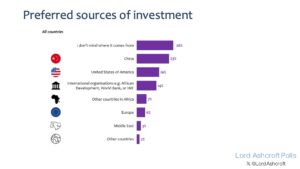
When we asked people in our poll where they would prefer foreign investment to come from, we found people to be bracingly pragmatic: the most common answer overall was “I don’t mind where it comes from if it improves life for people in my country”. Otherwise – once again – people were more likely to name China as their preferred investor than the US or other international sources.
There may be different reasons for this. I suspect a major one is that they want investment quickly and China seems prepared to provide it in ways they can see. We know that in 2024, President Xi pledged $51 billion in funding for Africa over the following three years. As for his motives, my guess is that the voters here can see China’s unashamed self-interest as clearly as anyone else – and that their conclusion is transactional: if it’s good for them and it’s good for us, let’s do business.
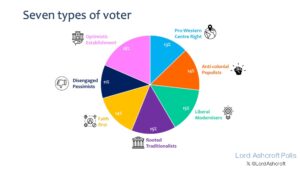
To broaden all this out into more general political terms, we can analyse our findings and break our 12,000 sample into seven distinct groups, each with a different combination of opinions and attitudes. The groups are represented in different proportions in each of the 10 countries we polled, as they will be in countries not included in our survey. The dynamics will also vary from country to country, but the characteristics of each segment illustrate some of the tensions that need to be reconciled within a successful voting coalition. The full details will be on my website but it’s worth briefly describing some of the segments.
The most natural supporters of the parties represented here will be what we have labelled the Pro-Western Centre-Right. These are the most firmly committed to democracy, have a very strong preference for alignment with the US and the West and tend to reject the idea that colonialism is to blame for their country’s problems. They have very positive views about capitalism and globalisation, but unfortunately are also the most likely to say they would emigrate if they had the chance.
The segment we have called the Optimistic Establishment are also very positive about their country’s future and their own, and are the most likely to agree that life will be better for future generations. They are also the most likely to see their country as an advanced economy and a modern, democratic state, and have higher levels of trust in public institutions.
The Rooted Traditionalists segment also tend not to put their country’s challenges down to colonialism, and share what we like to think of as the centre-right view that with hard work, anyone can succeed whatever their background. However, while the Pro-Western Centre right group tends to think they should become more like the world’s more advanced economies this segment thinks protecting traditional values is more important. They also prefer alignment with China and the East.
Our parties will probably find thin pickings among the Anti-Colonial Populists, who have very negative views of the west, are highly favourable towards China, and blame what they see as the lack of opportunity in their country on the legacy of colonialism.
As their name suggests, the Liberal Modernisers heavily prioritise modernising society, especially when it comes to opportunities for women and girls. They also think that old-fashioned attitudes and lack of freedom are the biggest barriers to progress, but they currently tend to favour left-leaning parties.
Those in the Faith First segment tend to consider a shared religion the most important connection between people, and feel strongly that their country can stand among the world’s leading economies without giving up what makes it unique. They have no strong political allegiance but tend to reject left-wing populists.
The Disengaged Pessimists also sound one of the least promising of the groups – they have the lowest level of trust in public institutions and, accordingly, lower levels of trust for established parties. At the same time, they should be open to a version of our message, since they see shared values as the strongest connection between people, and are the most likely to consider corruption, government debt, democratic rights and free speech to be major issues.
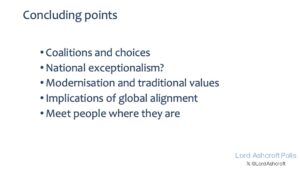
As I say, these groups will appear in difference shapes, sizes and varieties in different countries, but the exercise is a reminder that wherever they are in the world, successful parties win by building coalitions of voters with disparate but overlapping values and interests. Doing so means making choices, and I hope this research has highlighted some of the areas in which those choices will have to be made.
These choices include: how far to look to the example of other countries and how far to lean into national exceptionalism; how best to square modernisation with the need to respect the traditions and values that many hold dear; how to convince ambitious and enterprising young people that their future could look as bright at home as it might overseas; how far to align with other pro-market forces and the implications, both domestic and international, of a country’s choice of global allies and investment partners.
As we’ve known for some years and see confirmed week by week in different ways, the unipolar world and the idea that globalisation must triumph are passing into history. The global liberal order is being challenged externally, principally by Russia and China, and in domestic politics by people wanting to put national or sectional interests first in ways we have not seen since the end of the Cold War.
Part of our job on the centre right is to adapt to change while preserving the best of what’s gone before, and to be sceptical of the idea that there is anything inevitable about the arc of history or human improvement. My research suggests that people throughout Africa are enthusiastic about their country’s future and their own, but impatient for progress. For our parties to be in a position to deliver that progress will mean meeting people where they are, not where they once were. Pointing that out is what got me into this polling business 20 years ago, and it’s why I’m still at it today.