My latest poll looks at the Iran crisis, including Britain’s role and Keir Starmer’s handling of the situation, whether and how the state should subsidise energy bills, Shabana Mahmood’s proposed changes to indefinite leave to remain, North Sea drilling, support for Green policies, and Zack Polanski’s past as a hypnotherapist.
Starmer and Iran
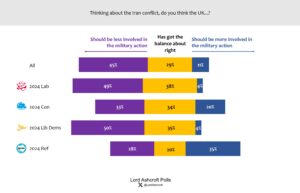
Only just over one in ten voters thought the UK should be more involved in military action in the Iran conflict. Just under half, including a majority of Green supporters, thought we should be less involved. Just under three in ten thought the UK had got the balance about right.
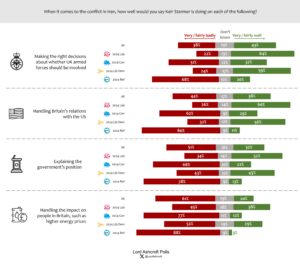
Looking at Keir Starmer’s performance over the Iran conflict, voters were more likely to think the PM was doing well than badly on making decisions about whether UK forces should be involved in the Iran conflict. However, by a small margin they thought the opposite when it came to handling Britain’s relations with the US, and only one in three thought he was doing a good job of explaining the government’s position. Most thought he was doing badly at handling the impact on people in Britain, such as higher energy prices.
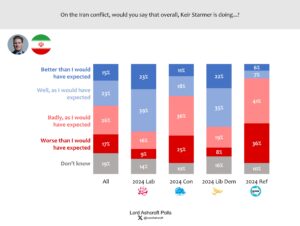
Voters were nearly as likely to say that Starmer was handling the Iran conflict better than they would have expected as to say he was doing worse. Overall, 38 per cent ten thought he was doing well or better than expected; 43 per cent thought he was doing badly or worse than expected.
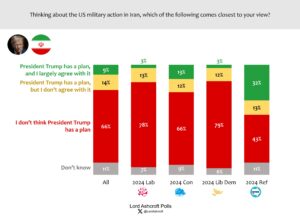
Two thirds said they didn’t think President Trump had a plan when it came to military action in Iran. This included majorities of all parties’ voters except Reform voters, (43 per cent of whom said he didn’t have a plan, and 32 per cent of whom said they thought he had a plan that they largely agreed with). Overall, just under a quarter thought Trump had a plan – they were more likely to disagree than agree with it.
Energy bills
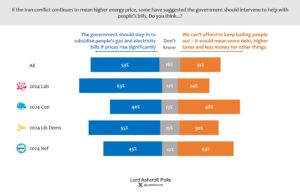
Just over half of voters said they thought the government should subsidise gas and electricity bills if prices rise significantly, with just over three in ten saying we can’t afford to keep bailing people out. Conservative voters were the only group more likely than not to agree with the second statement.
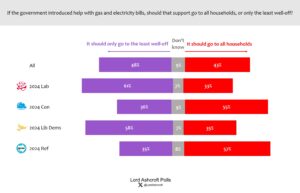
Overall, voters were closely divided between thinking any help with energy bills should only go to the least well-off or to all households. Majorities of Conservative and Reform voters thought any help should be available to everyone; most Labour, Lib Dem, Green and SNP voters said it should be targeted at the least well-off.
North Sea oil
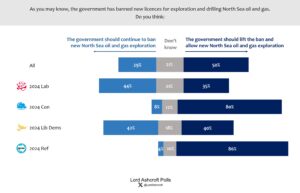
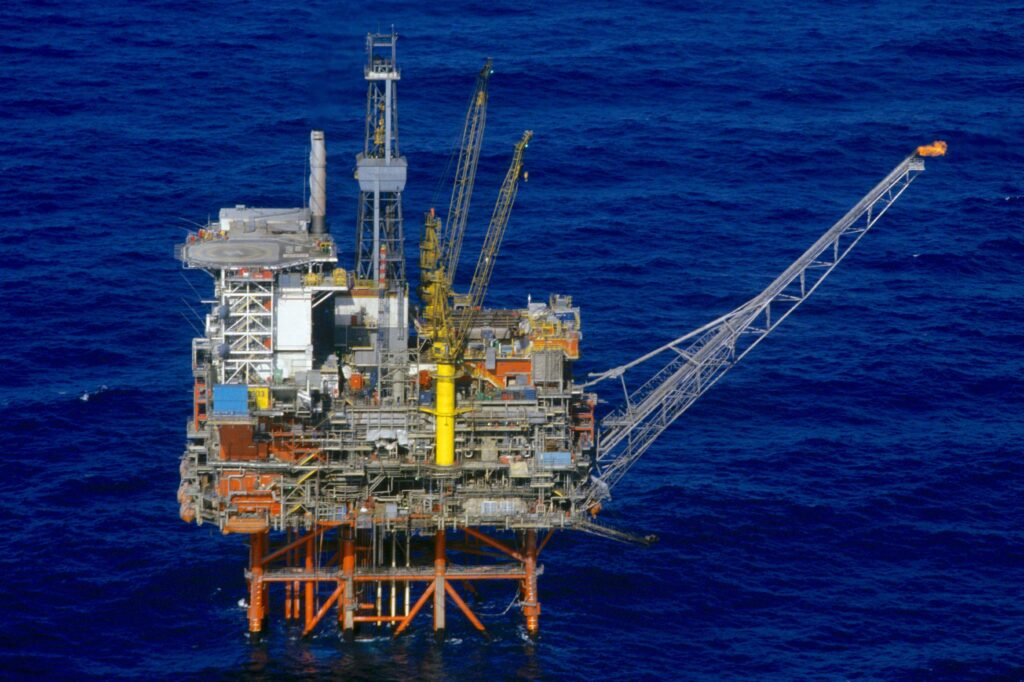
Voters said the government should lift the ban on new North Sea oil exploration by a 21-point margin. Two thirds of current and 2024 Green voters thought the ban should stay, making them the only group among whom a majority thought this. 2024 Labour voters thought the ban should continue by a 9-point margin.
Indefinite Leave to Remain

Just over one in five overall – including three in ten Labour supporters, 37% of Lib Dems and a majority of those intending to vote Green – said they thought the Home Secretary’s plan to double the time it takes for migrants to get indefinite leave to remain was too harsh. A majority said either that they thought the plan sounded about right or did not go far enough. Just under half of 2024 Conservatives and seven in ten Reform voters said the plan did not go far enough.

Only just under a quarter said they thought the government would end up going ahead with the proposed ILR changes, while nearly half said they probably wouldn’t. Current Labour and SNP supporters were the only groups more likely than not to think the plans would be implemented.
The Labour government – and what have they done?
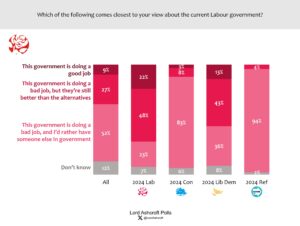
Just under one in ten overall said they thought the current Labour government was doing a good job, including 22 per cent of those who voted Labour in 2024. A further 27 per cent (including nearly half of 2024 Labour voters) said the government was doing a bad job but was still better than the alternatives. Just over half said the government was doing a bad job and they would rather have someone else in government.
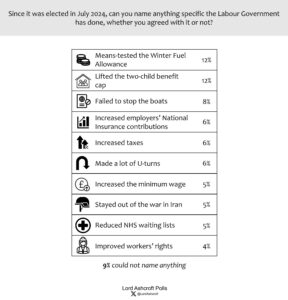
When we asked people to recall unprompted things that the Labour government had done, means testing the winter fuel allowance tied in first place with lifting the two-child benefit cap. Failing to stop the boats, higher taxes and U-turns took the next three places.
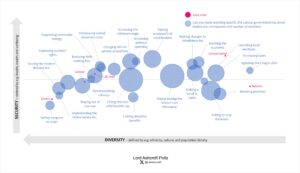
Our political map shows what kind of voters remember which government actions. The winter fuel allowance and the two-child benefit cap both appear close to the centre of the map, albeit on different sides of the central line, suggesting they were recalled largely across the board. Staying out the Iran war, workers’ rights, renationalising railways, renewable energy and breakfast clubs were most likely to be named in Labour/Lib Dem territory, with weapons sales to Israel most likely to be named in the Green corner of the map. Tax and the economy were most prominent in Conservative-leaning territory, while small boats and broken promises were most likely to be named in the bottom-right Reform-leaning quadrant.
The economy

Asked who would do the better job running the economy, voters chose Kemi Badenoch and Mel Stride over Keir Starmer and Rachel Reeves by a 3-point margin; just over four in ten said “don’t know”. Only 58 per cent of 2024 Labour voters named the Labour team; 73 per cent of 2024 Conservatives chose the Tory team.
The Green Party and Zack Polanski
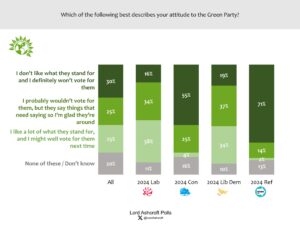
Asked about their view of the Green Party, three in ten said they didn’t like what it stood for and definitely wouldn’t vote for it. Half said either that they probably wouldn’t vote for the Greens but were glad they were around or that they liked a lot of what the Greens stood for and might well vote for them (38 per cent of 2024 Labour voters falling into this category).
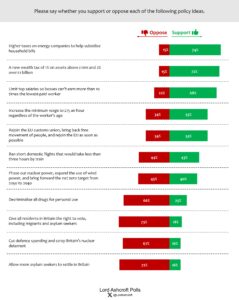
Asked about specific Green policy ideas, clear majorities supported higher taxes on energy companies, a wealth tax, and limiting top salaries. By smaller margins, people also backed raising the minimum wage to £15 an hour and rejoining the customs union, bringing back free movement and aiming to rejoin the EU.
Big majorities opposed allowing more asylum seekers to settle in Britain, allowing all residents to vote, cutting defence spending and scrapping the nuclear deterrent, and decriminalising all drugs for personal use. By smaller margins, voters opposed phasing out nuclear power, expanding wind power and bringing forward the net zero target, and banning short domestic flights.
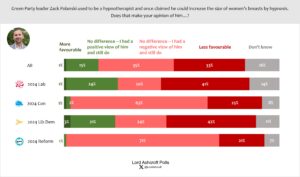
One in three said they felt less favourable towards Zack Polanski when told he had once claimed he could increase the size of women’s breasts by hypnosis. This included a quarter of current likely Green voters. Around half of likely Labour and Lib Dem voters also said it made them less favourable. Most Conservative and Reform leaners said they had an unfavourable view of Polanski before and still did.
Best (and most likely) prime minister – and the next election
In a head-to-head question, Starmer led Badenoch as best prime minister by 3 points. Those who voted Reform UK in 2024 said they preferred Badenoch to Starmer by a 58-point margin.
Given a choice between Starmer and Farage, voters as a whole chose Starmer by 15 points. 2024 Conservatives chose Farage over Starmer by 49 per cent to 18 per cent, while 2024 Labour voters chose Starmer by a 67-point margin.
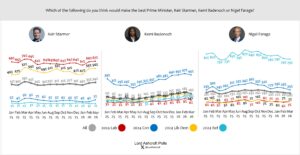
Offered a choice between Starmer, Badenoch and Farage, voters chose Starmer over Farage by a 14-point margin, with Badenoch in third place on 16 per cent. 2024 Conservative voters preferred Badenoch over Farage by a 20-point margin. Two thirds 2024 Labour voters preferred Starmer, with 7 per cent naming Farage and 6 per cent naming Badenoch.

Nigel Farage was thought the most likely person to be PM after the next election, with just under a quarter naming him as the most likely candidate. Only just over one in ten thought Starmer would still be in the job and 6 per cent named Badenoch. More than a quarter thought someone other than these three would be PM. Seven in ten of those currently intending to vote Reform thought Farage would be PM, compared to 38 per cent of current Labour leaners who thought Starmer would be PM and just under a quarter of current Conservative supporters who thought Badenoch would have the job.
When we asked how likely people were to end up voting for each party at the next election on a scale from zero to 100, those who voted Labour in 2024 put their chances of doing so again at the next election at an average of 42/100. Those who switched to Labour in 2024 put their chances of voting for the party again next time at 34/100, and those who switched from the Conservatives to Labour in 2024 put their chances of voting Labour again next time at an average of 28/100. Looking at those more likely than not to vote for a particular party (those whose highest likelihood of voting for one party was at least 50/100), we find Reform UK, the Greens and the Conservatives tied on 21 per cent, with Labour on 17 per cent, the Lib Dems on 9 per cent and Others on 11 per cent.
The political map
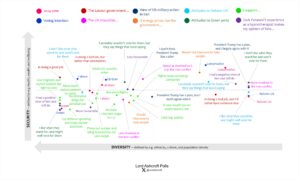
As above, our political map shows how different issues, attributes, personalities and opinions interact with one another. Each point shows where we are most likely to find people with that characteristic or opinion; the closer the plot points are to each other the more closely related they are. Here we see the distribution of support for various Green policies – the centre of gravity of backing for a wealth tax higher taxes on energy companies being closer to the centre of the map (and therefore having broader appeal) than cutting defence spending or giving migrants the right to vote. We also see how different parts of the electorate see Trump’s aims in Iran and Britain’s involvement, views of the Labour government, the Greens and Reform UK, and whether the state should subsidise household energy bills.