My latest polling looks at the Jenrick defection, government U-turns, social media and internet regulation, and Keir Starmer’s relationship with President Trump. We also ask how people would describe the party leaders and which parties they would want to see in coalition in the event of a hung parliament.
What have people noticed – and who has noticed what?
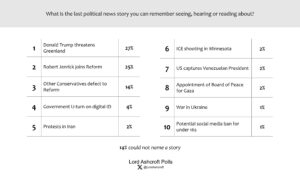
President Trump’s wish for the US to take over Greenland was the most noticed recent political news story. Domestically, the defection of Robert Jenrick and others from the Conservatives to Reform UK dominated people’s recollections, followed by the government’s change of policy on mandatory digital ID.
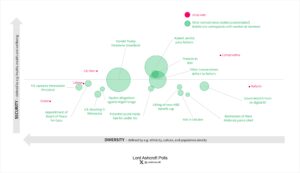
Our political map shows what kind of voters were most likely to recall which news. Stories about the defections to Reform appear close to the centre of the map, meaning they were recalled across the board, rather than by any particular kind of voter. News about Trump and Greenland, Venezuela and ICE were most likely to be mentioned by those on the Labour and Lib Dem-leaning left-hand side of the map, while stories including the digital ID U-turn and the retirement of the West Midlands chief constable following the ban on Israeli football fans were most often recalled in the Reform-leaning bottom right quadrant.
The Labour government
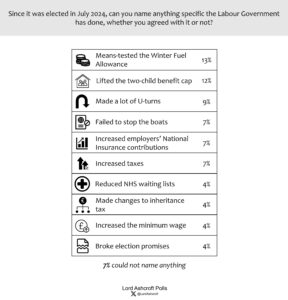
When we asked people to name something specific the Labour government had done since being elected in 2024, the most common answers were means testing the winter fuel allowance, lifting the two-child benefit cap, making U-turns, failing to stop small boat migration, and increasing employers’ National Insurance and other taxes.
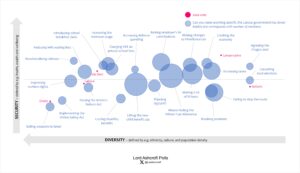
The winter fuel allowance, the two-child car and employers’ National Insurance were mentioned throughout the electorate. Other tax rises, small boats, cancelled local elections and the Chagos Islands deal were most likely to be recalled by those on the Conservative and Reform-leaning right hand side of the map, while the minimum wage, breakfast clubs, rental reforms and selling weapons to Israel were most likely to be remembered in Labour, Lib Dem and Green voting territory.
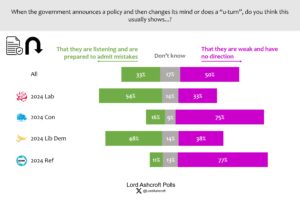
Overall, voters were more likely to say that U-turns show a government is weak and has no direction than that it is listening and prepared to admit mistakes. 2024 Labour and Lib Dem voters were slightly more likely to think they showed a government was listening – but more than one third of both groups thought it showed it was weak.
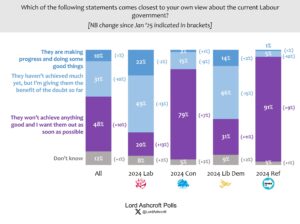
Only one in ten voters overall said the government was making progress and doing some good things (down from a quarter in January 2025). This included just over one fifth of those who voted Labour in 2024. A further 31 per cent overall said “they haven’t achieved much yet, but I’m giving them the benefit of the doubt so far” (down from 41 per cent a year ago). This included just under half of 2024 Labour voters. The biggest group of voters overall, including one fifth of 2024 Labour voters, said “they won’t achieve anything good and I want them out as soon as possible.”
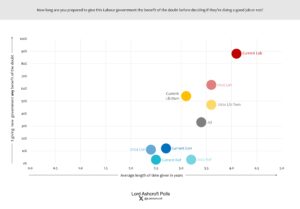
We asked for how long, if at all, people were prepared to give the Labour government the benefit of the doubt. Six in ten said either that they have given them until now and that’s enough, or that that they didn’t give the government the benefit of the doubt to begin with. This includes more than one third of those who voted Labour in 2024.
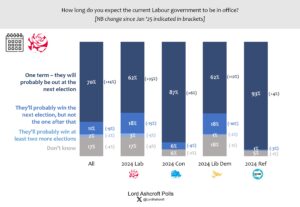
Seven in ten, including a clear majority of 2024 Labour voters, said they thought the Labour government would probably be out at the next election (up from just over half who said the same last January). Just over one in ten said they thought Labour would win one more term (down from 20 per cent this time last year), with just one in fifty expecting them to win at least two more elections.
Most effective opposition
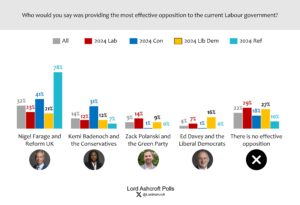
Just under one in three voters overall said Reform UK were providing the most effective opposition to the Labour government, with 14 per cent naming the Conservatives. 2024 Tory voters were more likely to name Farage and Reform than Badenoch and the Conservatives. Voters as a whole were more than twice as likely to name the Greens as the Lib Dems. Just over one in five said there was no effective opposition.
Preferred coalitions
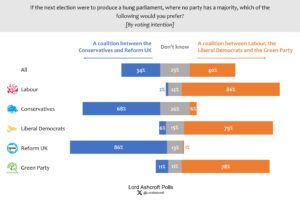
Overall, voters were slightly more likely to say they would prefer a Labour-Lib Dem-Green coalition than a Conservative-Reform coalition, with a quarter saying they didn’t know. Those currently intending to vote Labour, Green and Lib Dem overwhelmingly preferred a coalition of their parties. On the other side, 86 per cent of those leaning towards Reform said they would prefer a coalition of their party and the Conservatives. However, only just over two thirds of those intending to vote Conservative said they would prefer a coalition with Reform; more than a quarter of current Tories said they didn’t know which coalition they would prefer.
Trump and Starmer
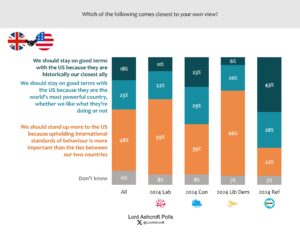
Voters overall were divided as to whether Britain should stand up more to the US or stay on good terms. The latter group was also divided as to whether we should do so because the US is historically our closest ally, or because it is the most powerful country in the world, whether or not we like what it is doing. Clear majorities of Labour, Lib Dem, Green and SNP voters said Britain should stand up more to the US.
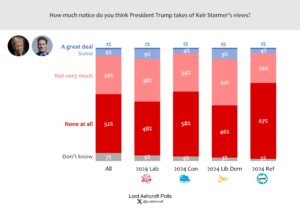
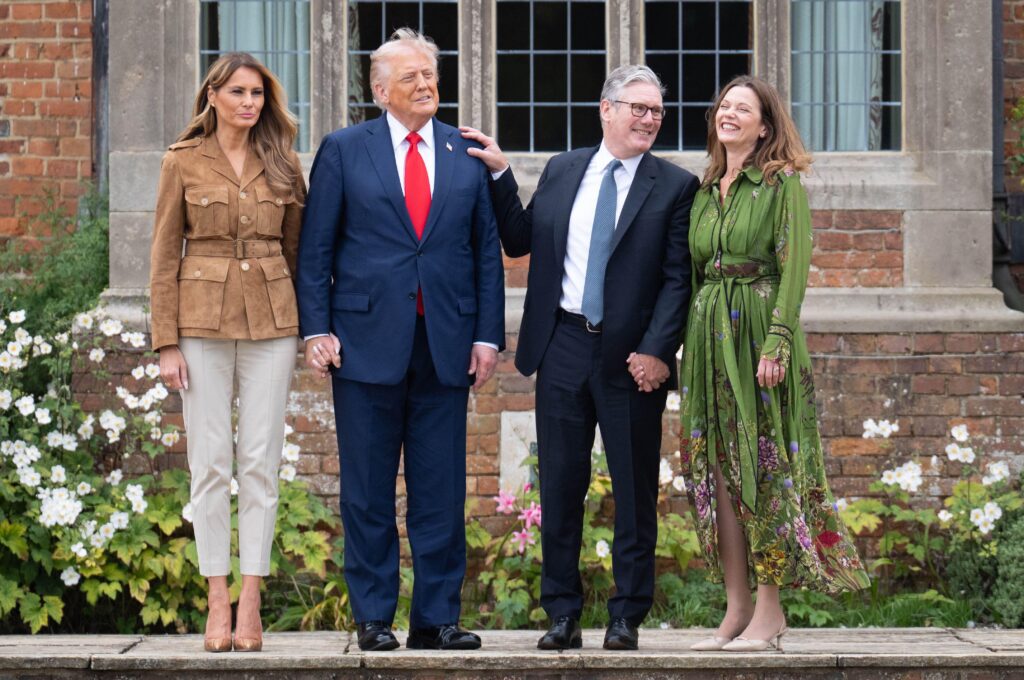
Only seven voters in a hundred thought President Trump took notice of Keir Starmer’s views, including only 10 per cent of 2024 Labour voters. Overall, 86 per cent thought he took either not very much notice or none at all.
Of those who thought President Trump takes little or no notice of Keir Starmer’s views, nearly seven in ten thought this was because he doesn’t take any notice of anyone. The remainder were more likely to think it was because Trump doesn’t respect Starmer than that Trump doesn’t respect Britain.
Jenrick defection
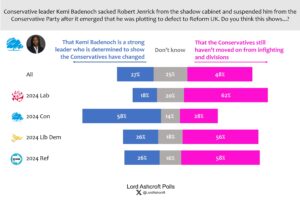
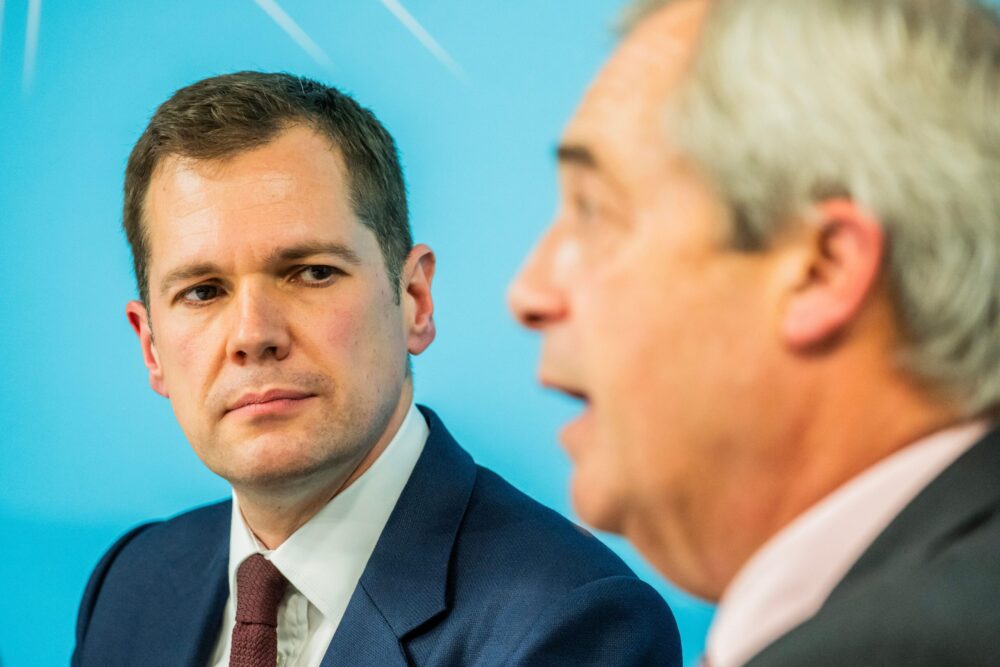
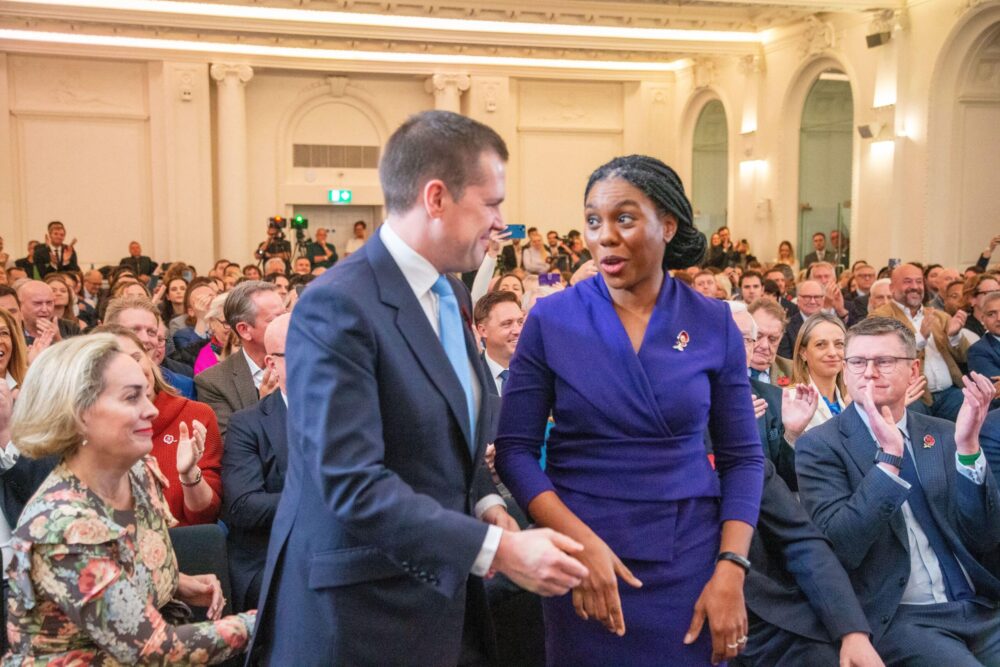
Overall, voters were more likely to say that Jenrick’s sacking showed the Conservatives hadn’t moved on from infighting and divisions than that Kemi Badenoch is a strong leader who is determined to show the Conservatives have changed. However, majorities of 2024 Conservatives and those currently intending to vote Conservative thought the episode showed Badenoch to be a strong leader, as did around a quarter of those who voted Lib Dem and Reform UK.
Social media and internet regulation
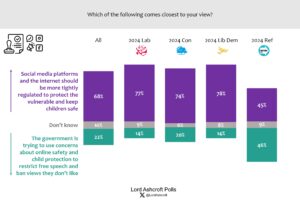
A clear majority agreed that social media platforms and the internet should be regulated more tightly to protect the vulnerable and keep children safe. Only just over one fifth agreed instead that the government was using concerns about online safety and child protection to restrict free speech and ban views they don’t like. There was a similar pattern for all political groups except 2024 Reform voters, who were closely divided between the two propositions.
The economy and optimism for Britain
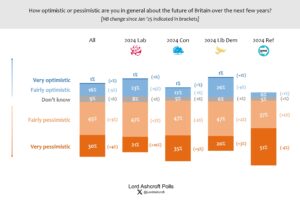
Three quarters of voters said they were pessimistic about the future of Britain over the next few years, including three in ten who said they were very pessimistic. Only 17 per cent said they were optimistic about the future of the country, down from 22 per cent this time last year.
2024 Labour and Lib Dem voters were the most optimistic, and Reform voters the least. Twenty seven per cent of those aged eighteen to twenty-four were optimistic, nearly twice as many as in all other age groups.
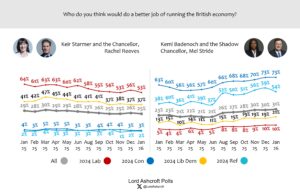
Asked who would do the better job running the economy, voters chose Kemi Badenoch and Mel Stride over Keir Starmer and Rachel Reeves by a 6-point margin, with 44 per cent saying “don’t know”. Only just over half of 2024 Labour voters named the Labour team; nearly three quarters of 2024 Conservatives chose the Tory team. Those who switched from the Conservatives to Labour in 2024 put Badenoch and Stride ahead by a 9-point margin, with 45% saying ‘don’t know’.
Party leaders and best prime minister
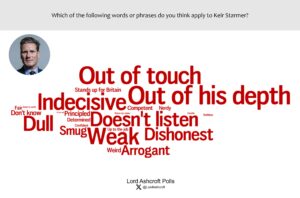
Offered a long list of positive and negative words and phrases, the words voters most often chose to describe Keir Starmer were “out of his depth”, “out of touch”, “weak”, “indecisive” and “dull”. Among 2024 Labour voters, the most chosen word was “indecisive”. Among those currently leaning towards Labour, the most chosen word was “principled”.
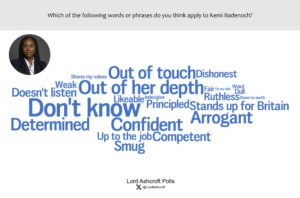
For Kemi Badenoch, the most chosen words overall were “out of her depth”, “confident”, “determined”, “out of touch” and “arrogant”. Among those currently intending to vote Conservative, the words most often chosen were “confident” and “determined”.
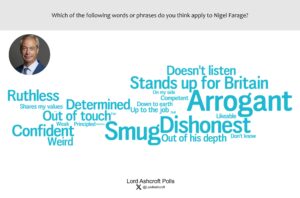
The words most often chosen for Nigel Farage were “arrogant”, “smug”, “dishonest”, “stands up for Britain” and “confident”. For those currently leaning towards Reform UK, by far the most chosen phrase was “stands up for Britain”.
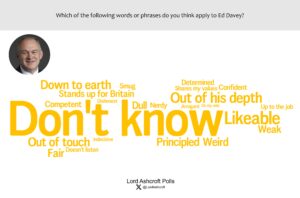
Fewer voters had an opinion of Ed Davey (nearly half said ‘don’t know’), but the words chosen most often were “likeable”, “out of his depth”, “down to earth”, “out of touch”, “principled”, “weird” and “fair”. For those currently intending to vote Lib Dem, by far the most chosen word was “likeable”.
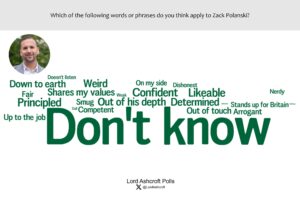
Fewer still had a view about Zack Polanski (57 per cent said ‘don’t know’), but the most chosen words were “principled”, “confident”, “likeable”, “determined”, “out of his depth” and “weird”. For those currently intending to vote Green, the most chosen words were “likeable” and “shares my values”.
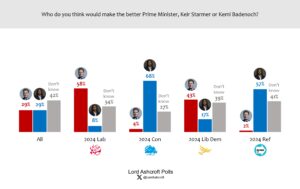
In a head-to-head question on who would make the best prime minister, Starmer and Badenoch were tied on 29 per cent, with 42 per cent saying “don’t know”. Fifty-eight of 2024 Labour voters say Starmer would make the better PM, while 68 per cent of 2024 Conservatives named Badenoch.
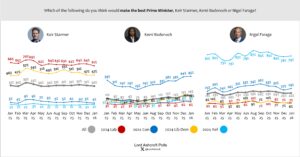
Offered a choice between Starmer, Badenoch and Farage, voters chose Starmer over Farage by an 8-point margin, with Badenoch in third place on 16 per cent. 2024 Conservative voters preferred Badenoch over Farage by a 16-point margin (up from six points in November).
Next general election
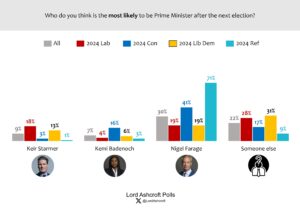
Nigel Farage was thought the most likely person to be PM after the next election, with 30 per cent naming him as the most likely candidate (down from 34 per cent in October). Fewer than one in ten thought Starmer would still be in the job. More than one fifth thought someone other than these three would be PM. Nearly eight in ten of those currently intending to vote Reform thought Farage would be in Downing Street, compared to 34 per cent of current Labour leaners who thought Starmer would be in place and a quarter of current Conservative supporters who thought Badenoch would be prime minister.
When we asked how likely people were to end up voting for each party at the next election on a scale from zero to 100, those who voted Labour in 2024, those who voted Labour in 2024 put their chances of doing so again at the next election at an average of 42 out of 100. Those who switched to Labour in 2024 put their chances of voting for the party again next time at 31 out of 100, and those who switched from the Conservatives to Labour in 2024 put their chances of voting Labour again next time at an average of 25 out of 100. Looking at those more likely than not to vote for a particular party (those whose highest likelihood of voting for one party was at least 50/100), this implies current vote shares of Reform UK 25 per cent, Conservative 21 per cent, Labour 18 per cent, Green 18 per cent, Lib Dems 11 per cent, Others 7 per cent.
The political map
As above, our political map shows how different issues, attributes, personalities and opinions interact with one another. Each point shows where we are most likely to find people with that characteristic or opinion; the closer the plot points are to each other the more closely related they are. Here see how different kinds of voters felt about issues including the government’s performance, their optimism for Britain, social media regulation, preferred coalitions and Britain’s relationship with the US.